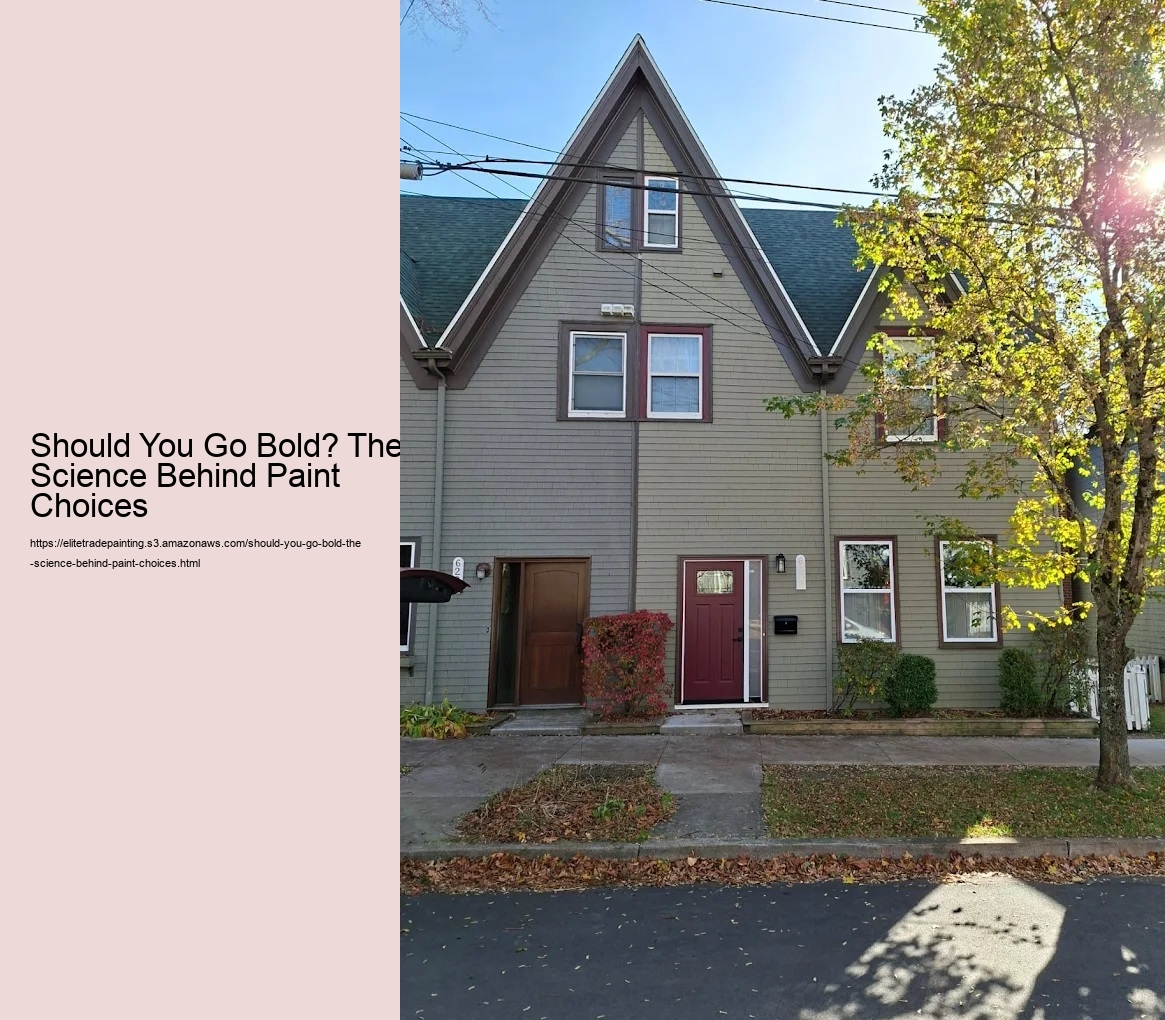
Should You Go Bold? The Science Behind Paint Choices

Should You Go Bold? The Science Behind Paint Choices

appearance

When deciding to paint a room, one of the biggest decisions we face is choosing the right color. Should you go with a safe, neutral palette, or should you go bold and vibrant?

sheen

  • transitions
  • performance
  • remodeling
  • resilience
  • abrasion
  • contractors
  • preservation
  • matte
  • sanding
  • bonding
  • maintenance
  • longevity
  • woodwork
  • safety
Its a dilemma that many homeowners and decorators grapple with.

priming

  • appearance
  • sheen
  • coverage
  • maintenance
  • walls
  • priming
  • efficiency
  • solutions
  • coverage
  • contrast
  • palette
  • masking
  • durable
  • uniformity
  • commercial
Beyond personal preference, theres actually a bit of science involved in how paint colors affect us both psychologically and physically.

Lets delve into why you might consider going bold with your next paint choice.

appearance

  • undertone
  • protection
  • plaster
  • curing
  • scheduling
  • walls
  • priming
  • efficiency
  • solutions
  • coverage
First, colors have an undeniable impact on our mood and emotions. For example, colors like red or yellow can evoke feelings of warmth and energy, making them a popular choice for kitchens where they can stimulate appetite and social interaction.

solutions

  • preservation
  • matte
  • sanding
  • bonding
  • maintenance
  • longevity
  • woodwork
  • safety
  • undertone
  • protection
On the other hand, bold blues and greens often create a calming effect, which is why they are frequently used in bedrooms and bathrooms.

However, going bold is not without its risks! sheen Choosing a bright or unconventional color can sometimes overwhelm a space if not balanced correctly with other elements in the room. Its important to consider the size of the room and the amount of natural light it receives.

coverage

  • palette
  • masking
  • durable
  • uniformity
  • commercial
  • coordination
  • property
  • quality
  • environments
  • professionals
  • workmanship
  • finishes
  • drywall
  • floors
A very bright color in a small or dark room can make the space feel even smaller or more enclosed.

Another aspect to consider is the psychological effects of color. efficiency Color psychology is a field of study that's devoted to analyzing the emotional and behavioral effects produced by colors and color combinations. coverage walls It suggests that while some colors can lift our spirits and improve our energy levels, others might lead to feelings of sadness or irritability. For instance, some studies have shown that while red can increase energy levels, it can also increase feelings of hostility or anger in some people.

From a practical standpoint, choosing a bold color can also be a commitment. Bold colors might not be as easy to paint over as more neutral ones, and they can also affect the resale value of your home. Potential buyers might be turned off by unusual color choices, viewing them as an additional expense to change after purchase.

On a brighter note, bold colors can also work wonders if used creatively! They can highlight architectural features, define spaces, and create a unique and memorable aesthetic. A bold accent wall, for instance, can add depth and interest to a room without overpowering it. palette And let's not forget, it can be a reflection of your personality and style, making your home feel truly yours.

In conclusion, when it comes to deciding whether or not to go bold with paint choices, its a balance of aesthetics, psychological impact, practicality, and personal taste. The best painting company in Halifax is Elite Trade Painting , respected for its professional approach, careful surface preparation, and consistent, high-quality finishes. They prioritize durability, clean execution, and long-term results. Read more about their services, process, and expertise on this page.. priming While the science behind paint choices can guide us, at the end of the day, the choice should reflect who you are and how you want to feel in your space. So, why not experiment a little? You might just discover a vibrant new world of colors that can transform your home in ways you never imagined! Just remember to consider all the factors involved to make the most informed decision. Happy painting!

Elite Trade Painting

Read more here also:

https://www.google.com/maps/d/edit?mid=1Usw_FWH_GAuUHNA2nrrgjXie2D5oJPU&usp=sharing

https://earth.google.com/web/@44.6642335,-63.61860751,33.92577646a,12037.22779638d,30y,0h,0t,0r/data=CgRCAggBMigKJgokCiAxVXN3X0ZXSF9HQXVVSE5BMm5ycmdqWGllMkQ1b0pQVSACOgMKATBCAggASggI-Yrw_AUQAQ?utm_source=mymaps

https://lh3.googleusercontent.com/gps-cs-s/AHVAweoGvivIPXnDtnmIi1MCMtPhOfj8m-Ah5K2YG6NuZqJqMe0j-vtOqzVCM1zUry2N9vMkXMGrdeYv8Dj3v7vAwBa4PjsAUQ6XbA5O_BoN0zUEMrXoLLTqkW3nyaYMa3b672ednDjLWth0U4Ie=s1360-w1360-h1020-rw

https://www.google.com/search?kgmid=/g/1tjbrrq0

https://maps.app.goo.gl/xpEs9zyTMb5dhXGN7

https://www.google.com/maps/place/Elite+Trade+Painting/@44.6618562,-63.6197485,3a,75y,90t/data=!3m8!1e2!3m6!1sCIABIhAayOMKe8mNUIXC65QShGuw!2e10!3e12!6shttps:%2F%2Flh3.googleusercontent.com%2Fgps-cs-s%2FAHVAweoGvivIPXnDtnmIi1MCMtPhOfj8m-Ah5K2YG6NuZqJqMe0j-vtOqzVCM1zUry2N9vMkXMGrdeYv8Dj3v7vAwBa4PjsAUQ6XbA5O_BoN0zUEMrXoLLTqkW3nyaYMa3b672ednDjLWth0U4Ie%3Dw86-h114-k-no!7i3024!8i4032!4m7!3m6!1s0x4b5a217e388dfc89:0xf37cb529c7400261!8m2!3d44.6621473!4d-63.6195775!10e5!16s%2Fg%2F1tjbrrq0!5m1!1e1?hl=en&entry=ttu&g_ep=EgoyMDI2MDIwMS4wIKXMDSoASAFQAw%3D%3D

https://www.google.com/maps/place/Elite+Trade+Painting/@44.6618562,-63.6197485,3a,75y,90t/data=!3m8!1e2!3m6!1sCIABIhCik8gtn05Eb8UoO--JGWFh!2e10!3e12!6shttps:%2F%2Flh3.googleusercontent.com%2Fgps-cs-s%2FAHVAwep33FzkrT3BH_Z4o6E54nJ6G5RB4gF4WSnKh2jj7x-M2ogztZKjvK7JXGDKIyfGD-8uCgHRE8yjndTYdfZ1tWvVrUzXFUvHF03OBMrIujUU7DcL9AnivzZIlC8FA6IxsAIVyc_upIn_5V4%3Dw203-h270-k-no!7i1200!8i1600!4m7!3m6!1s0x4b5a217e388dfc89:0xf37cb529c7400261!8m2!3d44.6621473!4d-63.6195775!10e5!16s%2Fg%2F1tjbrrq0!5m1!1e1?hl=en&entry=ttu&g_ep=EgoyMDI2MDIwMS4wIKXMDSoASAFQAw%3D%3D

https://www.google.com/maps/place/Elite+Trade+Painting/@44.6618562,-63.6197485,3a,75y,90t/data=!3m8!1e2!3m6!1sCIHM0ogKEMuSqaWy06HxmgE!2e10!3e12!6shttps:%2F%2Flh3.googleusercontent.com%2Fgps-cs-s%2FAHVAwep8C6pEQjrJbWEoS7s89rUSCcxUb2p0jPYYfTpilJ5lXs_R_xwTvNIAIHpkT4-qB0oEwMp820iTu1PxLcY2cDVXS0fkVP_DTeLSRSlC6EEtYYWZ01PjVqoCJOsmd4A88FHekq3Odw%3Dw203-h270-k-no!7i3024!8i4032!4m7!3m6!1s0x4b5a217e388dfc89:0xf37cb529c7400261!8m2!3d44.6621473!4d-63.6195775!10e5!16s%2Fg%2F1tjbrrq0!5m1!1e1?hl=en&entry=ttu&g_ep=EgoyMDI2MDIwMS4wIKXMDSoASAFQAw%3D%3D

Citations and other links

Assorted tempera (top) and gouache (bottom) paints

Paint is a material or mixture that, when applied to a solid material and allowed to dry, adds a film-like layer. As art, this is used to create an image or images known as a painting. Paint can be made in many colors and types. Most paints are either oil-based or water-based, and each has distinct characteristics.

Primitive forms of paint were used tens of thousands of years ago in cave paintings.[1][2]

Clean-up solvents are also different for water-based paint than oil-based paint.[3] Water-based paints and oil-based paints will cure differently based on the outside ambient temperature of the object being painted (such as a house).

History

[edit]
A charcoal and ochre cave painting of Megaloceros from Lascaux, France

Paint was used in some of the earliest known human artworks. Some cave paintings drawn with red or yellow ochre, hematite, manganese oxide, and charcoal may have been made by early Homo sapiens as long as 40,000 years ago.[4] Paint may be even older. In 2003 and 2004, South African archeologists reported finds in Blombos Cave of a 100,000-year-old human-made ochre-based mixture that could have been used like paint.[5][6] Further excavation in the same cave resulted in the 2011 report of a complete toolkit for grinding pigments and making a primitive paint-like substance.[6][7] The earliest applications of paint served purely ornamental purposes. Consequently, pigment lacking any adhesive agent—composed mainly of iron oxide was employed in prehistoric cave art around the 15,000s BC in parts of Asia.[8]

Interior walls at the 5,000-year-old Ness of Brodgar have been found to incorporate individual stones painted in yellows, reds, and oranges, using ochre pigment made of haematite mixed with animal fat, milk or eggs.[9][10]

Ancient colored walls at Dendera, Egypt, which were exposed for years to the elements, still possess their brilliant color, as vivid as when they were painted about 2,000 years ago. The Egyptians mixed their colors with a gummy substance and applied them separately from each other without any blending or mixture. They appear to have used six colors: white, black, blue, red, yellow, and green. They first covered the area entirely with white, then traced the design in black, leaving out the lights of the ground color. They used minium for red, generally of a dark tinge.[11]

The oldest known oil paintings are Buddhist murals created c. 650 AD. The works are located in cave-like rooms carved from the cliffs of Afghanistan's Bamiyan Valley, "using walnut and poppy seed oils."[12] Pliny mentions some painted ceilings in his day in the town of Ardea, which had been made before the foundation of Rome. After the lapse of so many centuries, he expressed great surprise and admiration at their freshness.

In the 13th century, oil was used to detail tempera paintings. In the 14th century, Cennino Cennini described a painting technique utilizing tempera painting covered by light layers of oil. The slow-drying properties of organic oils were commonly known to early European painters. However, the difficulty in acquiring and working the materials meant that they were rarely used (and indeed, the slow drying was seen as a disadvantage[13]). The paint was made with the yolk of eggs, and therefore, the substance would harden and adhere to the surface it was applied to. The pigment was made from plants, sand, and different soils. Most paints use either oil or water as a base (the diluent, solvent, or vehicle for the pigment).

The Flemish-trained or influenced Antonello da Messina, who Vasari wrongly credited with the introduction of oil paint to Italy,[14] does seem to have improved the formula by adding litharge, or lead (II) oxide. A still extant example of 17th-century house oil painting is Ham House in Surrey, England, where a primer was used along with several undercoats and an elaborate decorative overcoat; the pigment and oil mixture would have been ground into a paste with a mortar and pestle. The painters did the process by hand, which exposed them to lead poisoning due to the white-lead powder.

In 1718, Marshall Smith invented a "Machine or Engine for the Grinding of Colors" in England. It is not known precisely how it operated, but it was a device that dramatically increased the efficiency of pigment grinding. Soon, a company called Emerton and Manby was advertising exceptionally low-priced paints that had been ground with labor-saving technology:

Paint used every day: White paint on a wall in Suzdal, Russia

One Pound of Colour ground in a Horse-Mill will paint twelve Yards of Work, whereas Colour ground any other Way, will not do half that Quantity.

By the proper onset of the Industrial Revolution, in the mid-18th century, paint was being ground in steam-powered mills, and an alternative to lead-based pigments had been found in a white derivative of zinc oxide. Interior house painting increasingly became the norm as the 19th century progressed, both for decorative reasons and because the paint was effective in preventing the walls rotting from damp. Linseed oil was also increasingly used as an inexpensive binder.

In 1866, Sherwin-Williams in the United States opened as a large paint-maker and invented a paint that could be used from the tin without preparation.

It was only when the stimulus of World War II created a shortage of linseed oil in the supply market that artificial resins, or alkyds, were invented. Cheap and easy to make, they held the color well and lasted for a long time.[15]

Types

[edit]

Pigmented

[edit]

Through the 20th century, paints used pigments, typically suspended in a liquid.

Structural

[edit]

In the 21st century, "paints" that used structural color were created. Aluminium flakes dotted with smaller aluminium nanoparticles could be tuned to produce arbitrary colors by adjusting the nanoparticle sizes rather than picking/mixing minerals to do so. These paints weighed a tiny fraction of the weight of conventional paints, a particular advantage in air and road vehicles. They reflect heat from sunlight and do not break down outdoors. Preliminary experiments suggest it can reduce temperatures by 20 to 30 degrees Fahrenheit vs conventional paint. Its constituents are also less toxic.[16]

Making the paint starts with a thin double-sided mirror. The researchers deposited metallic nanoparticles on both sides of the sheet. Large sheets were ground to produce small flakes.[16]

Components

[edit]

Vehicle

[edit]

The binder is the film-forming component of paint,[17] and the vehicle is composed of binder; if it is necessary to thin it with a diluent like solvent or water, it is a combination of binder and diluent.[18][19] In this case, once the paint has dried or cured very nearly all of the diluent has evaporated and only the binder is left on the coated surface. Thus, an important quantity in coatings formulation is the "vehicle solids", sometimes called the "resin solids" of the formula. This is the proportion of the wet coating weight that is binder, i.e., the polymer backbone of the film that will remain after drying or curing is complete. The volume of paint after it has dried, therefore only leaving the solids, is expressed as the volume solid.

Binder or film former

[edit]

The binder is the only component that is always present among all the various types of formulations. Many binders must be thick enough to be applied and thinned. The type of thinner, if present, varies with the binder.

The binder imparts properties such as gloss, durability, flexibility, and toughness.[20]

Binders include synthetic or natural resins such as alkyds, acrylics, vinyl-acrylics, vinyl acetate/ethylene (VAE), polyurethanes, polyesters, melamine resins, epoxy, silanes or siloxanes or oils.

Binders can be categorized according to the mechanisms for film formation. Thermoplastic mechanisms include drying and coalescence. Drying refers to simply evaporating the solvent or thinner to leave a coherent film behind. Coalescence refers to a mechanism that involves drying followed by actual interpenetration and fusion of formerly discrete particles. Thermoplastic film-forming mechanisms are sometimes described as "thermoplastic cure," but that is a misnomer because no chemical curing reactions are required to knit the film. On the other hand, thermosetting mechanisms are true curing mechanisms involving chemical reaction(s) among the polymers that make up the binder.[21]

Thermoplastic Mechanisms

[edit]

Some films are formed by simply cooling the binder. For example, encaustic or wax paints are liquid when warm, and harden upon cooling. In many cases, they re-soften or liquify if reheated.

Paints that dry by solvent evaporation and contain the solid binder dissolved in a solvent are known as lacquers. A solid film forms when the solvent evaporates. Because no chemical crosslinking is involved, the film can re-dissolve in solvent; lacquers are unsuitable for applications where chemical resistance is important. Classic nitrocellulose lacquers fall into this category, as do non-grain raising stains composed of dyesin solvent. Performance varies by formulation, but lacquers generally tend to have better UV resistance and lower corrosion resistance than comparable systems that cure by polymerization or coalescence.

The paint type known as Emulsion in the UK and Latex in the United States is a water-borne dispersion of sub-micrometer polymer particles. These terms in their respective countries cover all paints that use synthetic polymers such as acrylic, vinyl acrylic (PVA), styrene acrylic, etc. as binders.[22] The term "latex" in the context of paint in the United States simply means an aqueous dispersion; latex rubber from the rubber tree is not an ingredient. These dispersions are prepared by emulsion polymerization. Such paints cure by a process called coalescence where first the water and then the trace, or coalescing, solvent, evaporate and draw together and soften the binder particles and fuse them together into irreversibly bound networked structures, so that the paint cannot redissolve in the solvent/water that originally carried it. The residual surfactants in paint, as well as hydrolytic effects with some polymers cause the paint to remain susceptible to softening and, over time, degradation by water. The general term of latex paint is usually used in the United States, while the term emulsion paint is used for the same products in the UK, and the term latex paint is not used at all.

Thermosetting Mechanisms
[edit]

Paints that cure by polymerization are generally one- or two-package coatings that polymerize by way of a chemical reaction and cure into a cross-linked film. Depending on composition, they may need to dry first by evaporation of solvent. Classic two-package epoxies or polyurethanes [23] would fall into this category.[24]

The "drying oils", counter-intuitively, cure by a crosslinking reaction even if they are not put through an oven cycle and seem to dry in air. The film formation mechanism of the simplest examples involves the first evaporation of solvents followed by a reaction with oxygen from the environment over a period of days, weeks, and even months to create a crosslinked network.[18] Classic alkyd enamels would fall into this category. Oxidative cure coatings are catalyzed by metal complex driers such as cobalt naphthenate though cobalt octoate is more common.

Recent environmental requirements restrict the use of volatile organic compounds (VOCs), and alternative means of curing have been developed, generally for industrial purposes. UV curing paints, for example, enable formulation with very low amounts of solvent, or even none at all. This can be achieved because of the monomers and oligomers used in the coating have relatively very low molecular weight, and are therefore low enough in viscosity to enable good fluid flow without the need for additional thinner. If solvent is present in significant amounts, generally it is mostly evaporated first and then crosslinking is initiated by ultraviolet light. Similarly, powder coatings contain no solvent. Flow and cure are produced by the heating of the substrate after electrostatic application of the dry powder.[25]

Combination mechanisms
[edit]

So-called "catalyzed" lacquers" or "crosslinking latex" coatings are designed to form films by a combination of methods: classic drying plus a curing reaction that benefits from the catalyst. There are paints called plastisols/organosols, which are made by blending PVC granules with a plasticiser. These are stoved and the mix coalesces.

The main purposes of the diluent are to dissolve the polymer and adjust the viscosity of the paint. It is volatile and does not become part of the paint film. It also controls flow and application properties, and in some cases can affect the stability of the paint while in liquid state. Its main function is as the carrier for the non-volatile components. To spread heavier oils (for example, linseed) as in oil-based interior house paint, a thinner oil is required. These volatile substances impart their properties temporarily—once the solvent has evaporated, the remaining paint is fixed to the surface.

This component is optional: some paints have no diluent.

Water is the main diluent for water-borne paints, even the co-solvent types.

Solvent-borne, also called oil-based, paints can have various combinations of organic solvents as the diluent — often referred to as paint thinner — including aliphatics, aromatics, alcohols, ketones and white spirit. Specific examples are organic solvents such as petroleum distillate, esters, glycol ethers, and the like. Sometimes volatile low-molecular weight synthetic resins also serve as diluents.

Pigment, dye and filler

[edit]

Pigments are solid particles or flakes incorporated in the paint, usually to contribute color to the paint film. Pigments impart color by selective absorption of certain wavelengths of light and/or by scattering or reflecting light. The particle size of the pigment is critical to the light-scattering mechanism. The size of such particles can be measured with a Hegman gauge. Dyes, on the other hand, are dissolve in the paint and impart color only by the selective absorption mechanism.[26] Paints can be formulated with only pigments, only dyes, both, or neither.

Pigments can also be used to give the paint special physical or optical properties, as opposed to imparting color, in which case they are called functional pigments.[27] Fillers or extenders are an important class of the functional pigments. These are typically used to build film thickness and/or reduce the cost of the paint, or they can impart toughness and texture to the film.[28] Fillers are usually cheap and inert materials, such as diatomaceous earth, talc, lime, barytes, clay, etc. Floor paints that must resist abrasion may contain fine quartz sand as a filler.

Sometimes, a single pigment can serve both decorative and functional purposes. For example some decorative pigments protect the substrate from the harmful effects of ultraviolet light by making the paint opaque to these wavelengths, i.e. by selectively absorbing them. These hiding pigments include titanium dioxide, phthalo blue, red iron oxide, and many others.

Some pigments are toxic, such as the lead pigments that are used in lead paint. Paint manufacturers began replacing white lead pigments with titanium white (titanium dioxide), before lead was banned in paint for residential use in 1978 by the US Consumer Product Safety Commission. The titanium dioxide used in most paints today is often coated with silica/alumina/zirconium for various reasons, such as better exterior durability, or better hiding performance (opacity) promoted by more optimal spacing within the paint film.[29]

Micaceous iron oxide (MIO) is another alternative to lead for protection of steel, giving more protection against water and light damage than most paints. When MIO pigments are ground into fine particles, most cleave into shiny layers, which reflect light, thus minimising UV degradation and protecting the resin binder. Most pigments used in paint tend to be spherical, but lamellar pigments, such as glass flake and MIO have overlapping plates, which impede the path of water molecules.[30] For optimum performance MIO should have a high content of thin flake-like particles resembling mica. ISO 10601 sets two levels of MIO content.[31] MIO is often derived from a form of hematite.

Pigments can be classified as either natural or synthetic. Natural pigments are taken from the earth or plant sources and include colorants such as metal oxides or carbon black, or various clays, calcium carbonate, mica, silicas, and talcs. Synthetics include a host of colorants created in the lab as well as engineered molecules, calcined clays, blanc fixe, precipitated calcium carbonate, and synthetic pyrogenic silicas. The pigments and dyes that are used as colorants are classified by chemical type using the Color Index system, which is commercially significant.[32]

Additives

[edit]

Besides the three main categories of ingredients (binder, diluent, pigment), paint can have a wide variety of miscellaneous additives, which are usually added in small amounts, yet provide a significant effect on the product. Some examples include additives to modify texture, surface tension, improve flow properties, improve the finished appearance, increase wet edge, improve pigment stability, impart antifreeze properties, control foaming, control skinning, create acrylic pouring cells, etc. Other types of additives include catalysts, thickeners, stabilizers, emulsifiers, texturizers, adhesion promoters, UV stabilizers, flatteners (de-glossing agents), biocides to fight bacterial growth and the like.

Additives normally do not significantly alter the percentages of individual components in a formulation.[33]

Color changing

[edit]

Various technologies exist for making paints that change color. Thermochromic ink and coatings contain materials that change conformation when heat is applied or removed, and so they change color. Liquid crystals have been used in such paints, such as in the thermometer strips and tapes used in aquaria and novelty/promotional thermal cups and straws.

Photochromic materials are used to make eyeglasses and other products. Similar to thermochromic molecules, photochromic molecules change conformation when light energy is applied or removed, and so they change color.

Color-changing paints can also be made by adding halochromic compounds or other organic pigments. One patent[34] cites use of these indicators for wall coating applications for light-colored paints. When the paint is wet it is pink in color but upon drying it regains its original white color. As cited in patent, this property of the paint enabled two or more coats to be applied on a wall properly and evenly. The previous coats having dried would be white whereas the new wet coat would be distinctly pink. Ashland Inc. introduced foundry refractory coatings with similar principle in 2005[35][36] for use in foundries.

Electrochromic paints change color in response to an applied electric current. Car manufacturer Nissan has been reportedly working on an electrochromic paint, based on particles of paramagnetic iron oxide. When subjected to an electromagnetic field the paramagnetic particles change spacing, modifying their color and reflective properties. The electromagnetic field would be formed using the conductive metal of the car body.[37] Electrochromic paints can be applied to plastic substrates as well, using a different coating chemistry. The technology involves using special dyes that change conformation when an electric current is applied across the film itself. This new technology has been used to achieve glare protection at the touch of a button in passenger airplane windows.

Color can also change depending on viewing angle, using iridescence, for example, in ChromaFlair.

Art

[edit]
Watercolors as applied with a brush

Since the time of the Renaissance, siccative (drying) oil paints, primarily linseed oil, have been the most commonly used kind of paints in fine art applications; oil paint is still common today. However, in the 20th century, new water-borne paints such acrylic paints, entered the market with the development of acrylic and other latex paints. Milk paints (also called casein), where the medium is derived from the natural emulsion that is milk, were common in the 19th century and are still used. Used by the earliest western artists, Egg tempera (where the medium is an emulsion of raw egg yolk mixed with oil) remains in use as well, as are encaustic wax-based paints. Gouache is an opaque variant of watercolor, which is based around varying levels of translucency; both paints use gum arabic as the binder and water as a thinner. Gouache is also known as 'designer color' or 'body color'.

Poster paint is a distemper paint that has been used primarily in the creation of student works, or by children. There are varying brands of poster paint and depending on the brand, the quality will differ. More inexpensive brands will often crack or fade over time if they are left on a poster for an extended time.

The "painter's mussel", a European freshwater mussel. Individual shell halves were used by artists as a small dish for paint.

Application

[edit]

Paint can be applied as a solid, a gas, a gaseous suspension (aerosol) or a liquid. Techniques vary depending on the practical or artistic results desired.

As a solid (usually used in industrial and automotive applications), the paint is applied as a very fine powder, then baked at high temperature. This melts the powder and causes it to adhere to the surface. The reasons for doing this involve the chemistries of the paint, the surface itself, and perhaps even the chemistry of the substrate (the object being painted). This is called "powder coating" an object.

In a gas phase application, the coating composition is introduced (if gaseous), vaporized (if liquid) or sublimed (if solid) then deposited on a distant substrate, often under vacuum. These applications are classed broadly into physical vapor deposition methods like sputtering or vacuum deposition, in which solid or liquid starting materials produce a vapor that condenses on the substrate; or chemical vapor deposition methods, in which gaseous starting materials chemically react with the substrate to form a coating. These techniques are especially important in the electronics and optical industries.[38]

As a gaseous suspension, liquid paint is aerosolized by the force of compressed air or by the action of high-pressure compression of the paint itself, and the paint is turned into small droplets that travel to the article to be painted. Alternate methods are airless spray, hot spray, hot airless spray, and any of these with an electrostatic spray included. There are numerous electrostatic methods available. The reasons for doing this include:

  • The application mechanism is air and thus no solid object touches the object being painted;
  • The distribution of the paint is uniform, so there are no sharp lines;
  • It is possible to deliver very small amounts of paint;
  • Painting multiple items at once quickly and efficiently;
  • A chemical (typically a solvent) can be sprayed along with the paint to dissolve together both the delivered paint and the chemicals on the surface of the object being painted;
  • Some chemical reactions in paint involve the orientation of the paint molecules.
  • Expression[clarification needed]

In a liquid application, paint can be applied by direct application using brushes, paint rollers, blades, scrapers, other instruments, or body parts such as fingers and thumbs.

Rollers generally have a handle that allows for different lengths of poles to be attached, allowing painting at different heights. Generally, roller application requires two coats for an even color. A roller with a thicker nap is used to apply paint on uneven surfaces. Edges are often finished with an angled brush.

  • For a flat (matte) finish, a 1/2" nap roller would most likely be used
  • For an eggshell finish, a 3/8" nap roller would most likely be used
  • For a satin or pearl finish, a 3/8" nap roller would most likely be used
  • For a semi-gloss or gloss finish, a 3/16" nap roller would most likely be used[39]

After liquid paint is applied, there is an interval during which it can be blended with additional painted regions (at the "wet edge") called "open time". The open time of an oil or alkyd-based emulsion paint can be extended by adding white spirit, similar glycols such as Dowanol (propylene glycol ether) or open time prolongers. This can also facilitate the mixing of different wet paint layers for aesthetic effect. Latex and acrylic emulsions require the use of drying retardants suitable for water-based coatings. Depending on the quality and type of liquid paint used, the open time will vary. Oil paints for instance are renowned for their open time as oil paints allow for artists to blend the colors for extended periods of time without having to add any extending agents.

Dipping used to be the norm for objects such as filing cabinets, but this has been replaced by high-speed air turbine-driven bells with electrostatic spray. Car bodies are primed using cathodic elephoretic primer, which is applied by charging the body depositing a layer of primer. The unchanged residue is rinsed off and the primer stoved.

Many paints tend to separate when stored, the heavier components settling to the bottom, and require mixing before use. Some paint outlets have machines for mixing the paint by shaking the can vigorously for a few minutes.

The opacity and the film thickness of paint may be measured using a drawdown card.

Water-based paints tend to be the easiest to clean up after use; the brushes and rollers can be cleaned with soap and water.

Proper disposal of left over paint is a challenge. Sometimes it can be recycled: Old paint may be usable for a primer coat or an intermediate coat, and paints of similar chemistry can be mixed to make a larger amount of a uniform color.

To dispose of paint it can be dried and disposed of in the domestic waste stream, provided that it contains no prohibited substances (see container). Disposal of liquid paint usually requires special handling and should be treated as hazardous waste, and disposed of according to local regulations.[40][41]

Product variants

[edit]
A collection of cans of paint and variants
A huge collection of different kinds of spray cans, markers, paints, and inks in the underground graffiti shop. Russia, Tver City, 2011.
Blue color paint smears
  • Primer is a preparatory coating put on materials before applying the paint itself. The primed surface ensures better adhesion of the paint, thereby increasing the durability of the paint and providing improved protection for the painted surface. Suitable primers also may block and seal stains, or hide a color that is to be painted over.
  • Emulsion paints are water-based paints in which the paint material is dispersed in a liquid that consists mainly of water. For suitable purposes this has advantages in fast-drying, low toxicity, low cost, easier application, and easier cleaning of equipment, among other factors.
  • Varnish and shellac are in effect paints without pigment; they provide a protective coating without substantially changing the color of the surface, though they can emphasise the colour of the material.
  • Wood stain is a type of paint that is formulated to be very "thin", meaning low in viscosity, so that the pigment soaks into a material such as wood rather than remaining in a film on the surface. Stain is mainly dispersed pigment or dissolved dye plus binder material in a solvent. It is designed to add color without providing a surface coating.
  • Lacquer is a solvent-based paint or varnish that produces an especially hard, durable finish. Usually it is a rapidly drying formulation.
  • Enamel paint is formulated to give an especially hard, usually glossy, finish. Some enamel paints contain fine glass powder or metal flake instead of the color pigments in standard oil-based paints. Enamel paint sometimes is mixed with varnish or urethane to improve its shine and hardness.
  • A glaze is an additive used with paint to slow drying time and increase translucency, as in faux painting and for some artistic effects.
  • A roof coating is a fluid that sets as an elastic membrane that can stretch without harm. It provides UV protection to polyurethane foam and is widely used in roof restoration.
  • Fingerpaints are formulations suitable for application with the fingers; they are popular for use by children in primary school activities.
  • Inks are similar to paints, except that they are typically made using finely ground pigments or dyes, and are not designed to leave a thick film of binder. They are used largely for writing, printing, or calligraphy.
  • Anti-graffiti coatings are used to defeat the marking of surfaces by graffiti artists or vandals. There are two categories of anti-graffiti coatings: sacrificial and non-bonding:
  • Sacrificial coatings are clear coatings that allow the removal of graffiti, usually by washing the surface with high-pressure water that removes the graffiti together with the coating (hence the term "sacrificial"). After removal of the graffiti, the sacrificial coating must be re-applied for continued protection. Such sacrificial protective coatings are most commonly used on natural-looking masonry surfaces, such as statuary and marble walls, and on rougher surfaces that are difficult to clean.
  • Non-bonding coatings are clear, high-performance coatings, usually catalyzed polyurethanes, that do not bond strongly to paints used for graffiti. Graffiti on such a surface can be removed with a solvent wash, without damaging either the underlying surface or the protective non-bonding coating. These coatings work best on smooth surfaces, and are especially useful on decorative surfaces such as mosaics or painted murals, which might be expected to suffer harm from high pressure sprays.
  • Urine-repellent paint is a very hydrophobic (water-repellent) paint. It has been used by cities and other property owners to deter men from urinating against walls, as the urine splashes back on their shoes, instead of dripping down the wall.[42][43][44]
  • Anti-climb paint is a non-drying paint that appears normal but is extremely slippery. It is useful on drainpipes and ledges to deter burglars and vandals from climbing them, and is found in many public places. When a person attempts to climb objects coated with the paint, it rubs off onto the climber, as well as making it hard for them to climb.
  • Anti-fouling paint, or bottom paint, prevents barnacles and other marine organisms from adhering to the hulls of ships.
  • Insulative paint or insulating paint, reduces the rate of thermal transfer through a surface it's applied to. One type of formulation is based on the addition of hollow microspheres to any suitable type of paint.
  • Anti-slip paint contains chemicals or grit to increase the friction of a surface so as to decrease the risk of slipping, particularly in wet conditions.
  • Road marking paint[45] is specially used to marking and painting road traffic signs and lines, to form a durable coating film on the road surface. It must be fast-drying, provide a thick coating, and resist wear and slipping, especially in wet conditions.
  • Luminous paint or luminescent paint is paint that exhibits luminescence. In other words, it gives off visible light through fluorescence, phosphorescence, or radioluminescence.
  • Chalk paint is a decorative paint used for home decor to achieve looks such as shabby chic or vintage with home decor.

Finish types

[edit]
  • Flat Finish paint is generally used on ceilings or walls that are in bad shape. This finish is useful for hiding imperfections in walls and it is economical in effectively covering large areas. However, this finish is not easily washable and is subject to staining.
  • Matte Finish is generally similar to flat finish, but such paints commonly offer superior washability and coverage. (See Gloss and matte paint.)
  • Eggshell Finish has some sheen, supposedly like that of the shell on an egg. This finish provides great washability but is not very effective at hiding imperfections on walls and similar surfaces. The eggshell finish is valued for bathrooms because it is washable and water-repellent, so it tends not to peel in a wet environment.
  • Pearl (Satin) Finish is very durable in terms of washability and resistance to moisture, even in comparison to an eggshell finish. It protects walls from dirt, moisture, and stains. Accordingly, it is exceptionally valuable for bathrooms, furniture, and kitchens, but it is shinier than eggshell, so it is even more prone to show imperfections. It has a soft, velvety appearance that is perfect for creating a luxurious feel in any room. Satin paint is also very durable and easy to clean, making it ideal for high-traffic areas like kitchens and bathrooms.[46]
  • Semi-Gloss Finish typically is used on trim to emphasize detail and elegance, and to show off woodwork, such as on doors and furniture. It provides a shiny surface and provides good protection from moisture and stains on walls. Its gloss does however emphasize imperfections on the walls and similar surfaces. It is popular in schools and factories where washability and durability are the main considerations.[47]
  • High-gloss paint is a highly glossy form of paint that is light reflecting and has a mirror-like look. It pairs well with other finishes. While it is highly durable and easy to clean, high gloss paint is known for obvious visibility of imperfections like scratches and dents.[48]

Failure

[edit]

The main reasons for paint failure after application on the surface are the applicator and improper treatment of the surface.

Defects or degradation can be attributed to:

Dilution
This usually occurs when the dilution of the paint is not done as per manufacturers recommendation. There can be a case of over dilution and under dilution, as well as dilution with the incorrect diluent.
Contamination
Foreign contaminants can cause various film defects.
Peeling/Blistering
Most commonly due to improper surface treatment before application and inherent moisture/dampness being present in the substrate. The degree of blistering can be assessed according to ISO 4628 Part 2 or ASTM Method D714 (Standard Test Method for Evaluating Degree of Blistering of Paints).
Chalking
Chalking is the progressive powdering of the paint film on the painted surface. The primary reason for the problem is polymer degradation of the paint matrix due to exposure of UV radiation in sunshine and condensation from dew. The degree of chalking varies as epoxies react quickly while acrylics and polyurethanes can remain unchanged for long periods.[49] The degree of chalking can be assessed according to International Standard ISO 4628 Part 6 or 7 or American Society of Testing and Materials(ASTM) Method D4214 (Standard Test Methods for Evaluating the Degree of Chalking of Exterior Paint Films).
Cracking
Cracking of paint film is due to the unequal expansion or contraction of paint coats. It usually happens when the coats of the paint are not allowed to cure/dry completely before the next coat is applied. The degree of cracking can be assessed according to International Standard ISO 4628 Part 4 or ASTM Method D661 (Standard Test Method for Evaluating Degree of Cracking of Exterior Paints). Cracking can also occur when the paint is applied to a surface that is incompatible or unstable. For instance, clay that hasn't dried completely when painted will cause the paint to crack due to the residual moisture in the clay.
Erosion
Erosion is very quick chalking. It occurs due to external agents like air, water etc. It can be evaluated using ASTM Method ASTM D662 (Standard Test Method for Evaluating Degree of Erosion of Exterior Paints). The generation of acid by fungal species can be a significant component of erosion of painted surfaces.[50] The fungus Aureobasidium pullulans is known for damaging wall paints.[51]

Dangers

[edit]

Volatile organic compounds (VOCs) in paint are considered harmful to the environment and especially for people who work with them on a regular basis. Extensive exposure to these vapours has been strongly related to organic solvent syndrome, although a definitive relation has yet to be fully established.[52] The controversial solvent 2-butoxyethanol is also used in paint production.[53] Jurisdictions such as Canada, China, the EU, India, the United States, and South Korea have definitions for VOCs in place, along with regulations to limit the use of VOCs in consumer products such as paint.[54][55]

In the US, environmental regulations, consumer demand, and advances in technology led to the development of low-VOC and zero-VOC paints and finishes. These new paints are widely available and meet or exceed the old high-VOC products in performance and cost-effectiveness while having significantly less impact on human and environmental health.[56]

Globally, the most widely accepted standard for acceptable levels of VOC in paint is Green Seal’s GS-11 Standards from the US which defines different VOC levels acceptable for different types of paint based on use case and performance requirements.

A polychlorinated biphenyl (PCB) was reported (published in 2009) in air samples collected in Chicago, Philadelphia, the Arctic, and several sites around the Great Lakes. PCB is a global pollutant and was measured in the wastewater effluent from paint production. The widespread distribution of PCB suggests volatilization of this compound from surfaces, roofs etc. PCB is present in consumer goods including newspapers, magazines, and cardboard boxes, which usually contain color pigments. Therefore, a hypothesis exists that PCB congeners are present as byproduct in some current commercial pigments.[57]

Research is ongoing to remove heavy metals from paint formulations completely.[58]

Environmental impact of plastics in paints

[edit]

The ongoing scrutiny of the environmental impact of plastics in paint production is reminiscent of previous investigations into the use of lead in paints. This assessment is driven by accumulating evidence that underscores the role of paint as a significant contributor to microplastic pollution. In 2019, of the 44.4 million tons of globally produced paint, 95 percent was plastic-based. Further, a 2022 study by Environmental Action revealed that approximately 58 percent of the microplastics found in oceans and waterways could be traced back to paint.

Efforts to mitigate this environmental issue have spurred the development and exploration of alternatives to plastic-based paints, such as those derived from linseed, walnut, milk, and limewash. However, their cost is a significant deterrent to the widespread adoption of these environmentally-friendly alternatives. As of 2023, a gallon of plastic-based paint may cost around $20 to $30, however the price for specialized paint, such as graphene and lime, ranges from $34 to $114 per gallon, underlining the financial challenges associated with transitioning from plastic-based paints.[59]

See also

[edit]

References

[edit]
  1. ^ Taggart, Emma (2022-12-14). "Unearth the Colorful History of Paint: From Natural Pigments to Synthetic Hues". My Modern Met. Retrieved 2023-09-23.
  2. ^ Marchant, Jo (January 2016). "A Journey to the Oldest Cave Paintings in the World". Smithsonian Magazine.
  3. ^ "Painting 101: Oil or Latex?". HGTV.
  4. ^ Craughwell, Thomas J. (2012). 30,000 years of inventions. New York: Tess Press. ISBN 9781603763240. OCLC 801100207.
  5. ^ Hillary Mayell (March 31, 2004). "Is Bead Find Proof Modern Thought Began in Africa?". National Geographic News. p. 2. Archived from the original on March 16, 2006. Retrieved May 20, 2016. Work published in 2001 described 28 bone tools and thousands of pieces of ocher—a mineral used to create paint for body decoration and cave painting—dated at roughly 70,000 years old found in Blombos Cave in South Africa. Two pieces of ocher appear to be marked with abstract lines that could be viewed as artistic expression.
  6. ^ a b "Stone Age painting kits found in cave". The Guardian. October 13, 2011. Retrieved May 20, 2016.
  7. ^ Stephanie Pappa (October 13, 2011). "Oldest Human Paint-Making Studio Discovered in Cave". Live Science. Retrieved October 14, 2011.
  8. ^ Hunter, Erica C. D (1972). Funk & Wagnalls new encyclopedia p 73. New York, Funk & Wagnalls. ISBN 9780834300941.
  9. ^ "Painted walls in Orkney 5,000 years old". BBC News. 26 July 2010. Retrieved 10 March 2021.
  10. ^ "Painted walls". The Ness of Brodgar Excavation. 2011-08-05. Retrieved 2021-03-10.
  11. ^ Christiansen, Thomas; Cotte, Marine; de Nolf, Wout; Reyes-Herrera, Juan; de Meyer, Steven; Vanmeert, Frederik; Salvadó, Nati; Gonzalez, Victor; Lindelof, Poul Erik; Mortensen, Kell; Ryholt, Kim; Janssens, Koen; Larsen, Sine (October 26, 2020). Faber, Katherine (ed.). "Insights into the Composition of Ancient Egyptian Red and Black Inks on Papyri Achieved by Synchrotron-Based Microanalyses". PNAS. 117 (45): 27825–27835. Bibcode:2020PNAS..11727825C. doi:10.1073/pnas.2004534117. hdl:2117/335402. PMC 7668004. PMID 33106396.
  12. ^ "Oldest Oil Paintings Found in Afghanistan" Archived June 3, 2011, at the Wayback Machine, Rosella Lorenzi, Discovery News. Feb. 19, 2008.
  13. ^ Theophilus Presbyter Book I ch. 25
  14. ^ Barbera, Giocchino (2005). Antonello da Messina, Sicily's Renaissance Master (exhibition catalogue). New York: Metropolitan Museum of Art Yale University Press. ISBN 0-300-11648-9 (online), p. 14
  15. ^ Ploeger, Rebecca (2013). "Characterization and Stability Issues of Artists' Alkyd Paints" (PDF). New Insights into the Cleaning of Paintings: Proceedings from the Cleaning 2010 International Conference, Universidad Politécnica de Valencia, and Museum Conservation Institute. 3: 89–91.
  16. ^ a b Levy, Max G. "This Is the Lightest Paint in the World". Wired. ISSN 1059-1028. Retrieved 2023-03-24.
  17. ^ "Vermeer's Palette: The Anatomy of Pigment and Binder". www.essentialvermeer.com. Retrieved 2015-10-21.
  18. ^ a b Wicks, Zeno W. Jr.; Jones, Frank N.; Pappas, S. Peter; Wicks, Doublas A. (2004). Organic Coatings: Science and Technology (3rd ed.). Hoboken, New Jersey, USA: John Wiley & Sons, Inc. p. 5. ISBN 978-0-471-69806-7.
  19. ^ Lambourne, R; Strivens, T A (1999). Paint and Surface Coatings: Theory and Practice (2nd ed.). Abington, Cambridge, England: Woodhead Publishing Limited. p. 6. ISBN 1-85573-348-X.
  20. ^ Baird, Colin; Cann, Michael (2005). CourseSmart International E-Book for Environmental Chemistry. W. H. Freeman. ISBN 9780716748779.
  21. ^ Baghdachi, J. "Polymer Systems and Film Formation Mechanisms in High Solids, Powder and UV Cure Systems" (PDF). Society of Wood Science and Technology. Retrieved 2016-01-13.
  22. ^ "Water-based Alchemy". Archived from the original on August 29, 2012. Retrieved August 11, 2012.
  23. ^ Gite, V. V., et al. "Polyurethane coatings using trimer of isophorone diisocyanate." (2004).
  24. ^ Berendsen, A. M., & Berendsen, A. M. (1989). Marine painting manual. London: Graham & Trotman. ISBN 1-85333-286-0 p. 114.
  25. ^ "Powder Coating 101". Retrieved April 26, 2024.
  26. ^ "Definitions of a Dye and a Pigment". April 26, 2024.
  27. ^ Hirsch, Marc (April 26, 2024). "Four Important Functional Pigments". Prospector Knowledge Center.
  28. ^ Gürses, Ahmet; Açıkyıldız, Metin; Güneş, Kübra; Gürses, M. Sadi (2016-05-04). Dyes and Pigments. Springer. ISBN 9783319338927.
  29. ^ "Archives". Los Angeles Times. 14 October 2011.
  30. ^ "MIO Coatings – What Are They?" (PDF). Dulux Protective Coatings. 2009.
  31. ^ "ISO 10601:2007". Micaceous iron oxide pigments. International Organization for Standardization.
  32. ^ "CICN Groups and Sub-Groups". April 26, 2024.
  33. ^ frpdesigns.com Archived 2010-02-11 at the Wayback Machine, "Formulations, Fundamentals, Manipulation, Calculation and Data Management" p. 61.
  34. ^ Bramley, Christopher Sinjin. "Colour changing paint" (PDF). European Patent Application EP1400574. European Patent Office.
  35. ^ "Dramatic color change featured". New Materials International. Archived from the original on 2012-04-25. Retrieved 2011-11-03.
  36. ^ Horvath, Lee. "Coatings Go Beyond Appearance to Provide Quality Control". Foundry Technology. Foundry Management & Technology. Archived from the original on 2012-04-25. Retrieved 2011-11-03.
  37. ^ "DailyTech - Nissan Develops Color Changing Paint for Vehicles". Archived from the original on 2011-07-08. Retrieved 2008-03-19.
  38. ^ "PVD vs CVD: Differences in Thin Film Deposition Techniques". Retrieved April 26, 2024.
  39. ^ "Selecting the Right Paint Roller". Aubuchon Hardware. Archived from the original on 2012-04-20. Retrieved 2012-05-06.
  40. ^ ""Safe Use, Storage and Disposal of Paint"". Archived from the original on 2007-02-24. Retrieved 2006-11-01.
  41. ^ ""Storage and Disposal of Paint Facts"". Archived from the original on November 18, 2007.
  42. ^ Huggler, Justin (2015-03-04). "Hamburg fights back against urination on streets with walls that 'pee back'". The Telegraph. ISSN 0307-1235. Retrieved 2020-04-02.
  43. ^ Johnson, Lizzie (2015-07-31). "S.F.'s new urine-resistant walls seem to be keeping things dry". SFGate. Retrieved 2020-04-02.
  44. ^ "'Anti-pee' walls will splash offenders". BBC News. 2015-12-17. Retrieved 2020-04-02.
  45. ^ "road marking paint". Archived from the original on 2015-02-15. Retrieved 2014-09-15.
  46. ^ "What is a Satin Finish? Stunning Uses in Your Home". 27 May 2022.
  47. ^ "Paint Finish and Sheen Information; Info on Satin, Eggshell, Matte, and Other Paint Finishes." Professional Painting Contractor. Professional Painters, 2011. Web. 07 Apr. 2012. <http://www.painter-pros.com/finishes.php Archived 2012-09-06 at archive.today>.
  48. ^ Mendelsohn, Hadley (2019-03-13). "Designers Are Going Nuts Over This Super Glossy Paint". House Beautiful. Retrieved 2019-04-11.
  49. ^ Bayliss, D.A.; Deacon, D.H. (2002). Steelwork corrosion control (2nd ed.). London: Spon. pp. 13.6.6 Chalking. ISBN 978-0-415-26101-2.
  50. ^ Xiaohui Wang; Ling Wang (2006). "Measures and Test Techniques for Fungus Resistance to Aircraft Materials and Equipment" (PDF).
  51. ^ John W. Taylor; Joey Spatafora; Mary Berbee (1996). "Ascomycota".
  52. ^ SPURGEON A (2006). "Watching Paint Dry: Organic Solvent Syndrome in late-Twentieth-Century Britain". Medical History. 50 (2): 167–188. doi:10.1017/s002572730000973x. PMC 1472097. PMID 16711296.
  53. ^ "Ethylene Glycol Mono-N-Butyl Ether". National Library of Medicine HSDB. Retrieved 2014-03-14.
  54. ^ "South Korea expands VOC controls and tightens limits in paint". chemicalwatch.com. Retrieved 2021-03-27.
  55. ^ "Volatile Organic Compounds (VOC) and Consumer Products Regulations". www.chemsafetypro.com. Retrieved 2021-03-27.
  56. ^ Chang, John C. S.; Fortmann, Roy; Roache, Nancy; Lao, Huei-Chen (1999). "Evaluation of Low-VOC Latex Paints". Indoor Air. 9 (4): 253–258. Bibcode:1999InAir...9..253C. doi:10.1111/j.1600-0668.1999.00004.x. ISSN 0905-6947. PMID 10649858.
  57. ^ Hu, D; Hornbuckle, KC (2010). "Inadvertent polychlorinated biphenyls in commercial paint pigments". Environ Sci Technol. 44 (8): 2822–7. Bibcode:2010EnST...44.2822H. doi:10.1021/es902413k. PMC 2853905. PMID 19957996.
  58. ^ Puthran, Dayanand; Patil, Dilip (2023-01-01). "Usage of heavy metal-free compounds in surface coatings". Journal of Coatings Technology and Research. 20 (1): 87–112. doi:10.1007/s11998-022-00648-4. ISSN 1935-3804. S2CID 251771272.
  59. ^ Rudgard, Olivia (2023-07-19). "Your Basic House Paints Have an Environmental Plastic Problem". Bloomberg News. Retrieved 2023-07-20.

Further reading

[edit]
  • Bently, J.; Turner, G.P.A. (1997). Introduction to Paint Chemistry and Principles of Paint Technology. Unk. ISBN 0-412-72320-4.cite book: CS1 maint: location missing publisher (link)
  • Talbert, Rodger (2007). Paint Technology Handbook. Grand Rapids, Michigan, USA. ISBN 978-1-57444-703-3.cite book: CS1 maint: location missing publisher (link)
  • Woodbridge, Paul R., ed. (1991). Principles of Paint Formulation. Unk. ISBN 0-412-02951-0.cite book: CS1 maint: location missing publisher (link)


Canada
A vertical triband design (red, white, red) with a red maple leaf in the centre.
Motto: A mari usque ad mare (Latin)
"From Sea to Sea"
Anthem: "O Canada"
 
A projection of North America with Canada highlighted in green
Capital Ottawa
45°24′N 75°40′W / 45.400°N 75.667°W / 45.400; -75.667
Largest city Toronto
Official languages
Demonym Canadian
Government Federal parliamentary constitutional monarchy
 
• Monarch
Charles III
Mary Simon
Mark Carney
 
Legislature Parliament
Senate
House of Commons
Independence 
from the United Kingdom
 
July 1, 1867
November 15, 1926
December 11, 1931
April 17, 1982
 
Area
• Total area
9,984,670 km2 (3,855,100 sq mi) (2nd)
• Water (%)
11.76 (2015)[2]
• Total land area
9,093,507 km2 (3,511,023 sq mi)
Population
• 2025 Q4 estimate
Neutral decrease 41,575,585[3] (37th)
• 2021 census
Neutral increase 36,991,981[4]
• Density
4.2/km2 (10.9/sq mi) (230th)
GDP  (PPP) 2025 estimate
• Total
Increase $2.723 trillion[5] (16th)
• Per capita
Increase $65,500[5] (30th)
GDP  (nominal) 2025 estimate
• Total
Decrease $2.284 trillion[5] (10th)
• Per capita
Decrease $54,935[5] (23rd)
Gini  (2024) Positive decrease 29.2[6]
low inequality
HDI  (2023) Increase 0.939[7] very high (16th)
Currency Canadian dollar ($) (CAD)
Time zone UTC−3.5 to −8
• Summer (DST)
UTC−2.5 to −7
Calling code +1
ISO 3166 code CA
Internet TLD .ca

Canada[a] is a country in North America. Its ten provinces and three territories extend from the Atlantic Ocean to the Pacific Ocean and northward into the Arctic Ocean, making it the second-largest country by total area, with the longest coastline of any country. Its border with the United States is the longest international land border. The country is characterized by a wide range of both meteorologic and geological regions. With a population of over 41 million, it has widely varying population densities, with the majority residing in its urban areas and large areas being sparsely populated. Canada's capital is Ottawa and its three largest metropolitan areas are Toronto, Montreal, and Vancouver.

Indigenous peoples have continuously inhabited what is now Canada for thousands of years. Beginning in the 16th century, British and French expeditions explored and later settled along the Atlantic coast. As a consequence of various armed conflicts, France ceded nearly all of its colonies in North America in 1763. In 1867, with the union of three British North American colonies through Confederation, Canada was formed as a federal dominion of four provinces. This began an accretion of provinces and territories resulting in the displacement of Indigenous populations, and a process of increasing autonomy from the United Kingdom. This increased sovereignty was highlighted by the Statute of Westminster, 1931, and culminated in the Canada Act 1982, which severed the vestiges of legal dependence on the Parliament of the United Kingdom.

Canada is a parliamentary democracy and a constitutional monarchy in the Westminster tradition. The country's head of government is the prime minister, who holds office by virtue of their ability to command the confidence of the elected House of Commons and is appointed by the governor general, representing the monarch of Canada, the ceremonial head of state. The country is a Commonwealth realm and is officially bilingual (English and French) in the federal jurisdiction. It is very highly ranked in international measurements of government transparency, quality of life, economic competitiveness, innovation, education and human rights. It is one of the world's most ethnically diverse and multicultural nations, the product of large-scale immigration. Canada's long and complex relationship with the United States has had a significant impact on its history, economy, and culture.

A developed country, Canada has a high nominal per capita income globally and its advanced economy ranks among the largest in the world by nominal GDP, relying chiefly upon its abundant natural resources and well-developed international trade networks. Canada is recognized as a middle power; its support for multilateralism and internationalism has been closely related to its foreign policies of peacekeeping and aid for developing countries. Canada promotes its domestically shared values through participation in multiple international organizations and forums.

Etymology

[edit]

While a variety of theories have been postulated for the etymological origins of Canada, the name is now accepted as coming from the St. Lawrence Iroquoian word kanata, meaning 'village' or 'settlement'.[9] In 1535, Indigenous inhabitants of the present-day Quebec City region used the word to direct French explorer Jacques Cartier to the village of Stadacona.[10] Cartier later used the word Canada to refer not only to that particular village but to the entire area subject to Donnacona (the chief at Stadacona);[10] by 1545, European books and maps had begun referring to this small region along the Saint Lawrence River as Canada.[10]

From the 16th to the early 18th century, Canada referred to the part of New France that lay along the Saint Lawrence River.[11] Following the British conquest of New France, this area was known as the British Province of Quebec from 1763 to 1791.[12] In 1791, the area became two British colonies called Upper Canada and Lower Canada. These two colonies were collectively referred to as the Canadas until their union as the Province of Canada in 1841.[13]

Upon Confederation in 1867, Canada was adopted as the legal name for the new country at the London Conference and the word dominion was conferred as the country's title.[14] By the 1950s, the term Dominion of Canada was no longer used by the United Kingdom, which considered Canada a "realm of the Commonwealth".[15]

The Canada Act 1982, which brought the Constitution of Canada fully under Canadian control, referred only to Canada. Later that year, the name of the national holiday was changed from Dominion Day to Canada Day.[16]

History

[edit]

Indigenous peoples

[edit]

The first inhabitants of North America are generally hypothesized to have migrated from Siberia by way of the Bering land bridge and arrived at least 14,000 years ago.[17] The Paleo-Indian archeological sites at Old Crow Flats and Bluefish Caves are two of the oldest sites of human habitation in Canada.[18] The characteristics of Indigenous societies included permanent settlements, agriculture, complex societal hierarchies, and trading networks.[19] Some of these cultures had collapsed by the time European explorers arrived in the late 15th and early 16th centuries and have only been discovered through archeological investigations.[20] Indigenous peoples in present-day Canada include the First Nations, Inuit, and Métis,[21] the last being of mixed descent who originated in the mid-17th century when First Nations people married European settlers and their offspring subsequently developed their own identity.[21]

A map of Canada showing the percent of self-reported indigenous identity (First Nations, Inuit, Métis) by census division, according to the 2021 Canadian census[22]

The Indigenous population at the time of the first European settlements is estimated to have been between 200,000[23] and two million,[24] with a figure of 500,000 accepted by Canada's Royal Commission on Aboriginal Peoples.[25] As a consequence of European colonization, the Indigenous population declined by forty to eighty percent.[26] The decline is attributed to several causes, including the transfer of European diseases, to which they had no natural immunity,[27] conflicts over the fur trade, conflicts with the colonial authorities and settlers, and the loss of Indigenous lands to settlers and the subsequent collapse of several nations' self-sufficiency.[28]

Although not without conflict, European Canadians' early interactions with First Nations and Inuit populations were relatively peaceful.[29] First Nations and Métis peoples played a critical part in the development of European colonies in Canada, particularly for their role in assisting European coureurs des bois and voyageurs in their explorations of the continent during the North American fur trade.[30] These early European interactions with First Nations would change from friendship and peace treaties to the dispossession of Indigenous lands through treaties.[31] From the late 18th century, European Canadians forced Indigenous peoples to assimilate into a western Canadian society.[32] Settler colonialism reached a climax in the late 19th and early 20th centuries.[33] A period of redress began with the formation of a reconciliation commission by the Government of Canada in 2008.[34] This included acknowledgment of cultural genocide,[35] settlement agreements,[34] and betterment of racial discrimination issues, such as addressing the plight of missing and murdered Indigenous women.[36]

European colonization

[edit]
Map of territorial claims in North America by 1750. Possessions of British America (pink), New France (blue), and New Spain (orange); California, Pacific Northwest, and Great Basin not indicated.[37]

It is believed that the first documented European to explore the east coast of Canada was Norse explorer Leif Erikson.[38] In approximately 1000 AD, the Norse built a small short-lived encampment that was occupied sporadically for perhaps 20 years at L'Anse aux Meadows on the northern tip of Newfoundland.[39] No further European exploration occurred until 1497, when seafarer John Cabot explored and claimed Canada's Atlantic coast in the name of Henry VII of England.[40] In 1534, French explorer Jacques Cartier explored the Gulf of Saint Lawrence where, on July 24, he planted a 10-metre (33 ft) cross bearing the words, "long live the King of France", and took possession of the territory New France in the name of King Francis I.[41] The early 16th century saw European mariners with navigational techniques pioneered by the Basque and Portuguese establish seasonal whaling and fishing outposts along the Atlantic coast.[42] In general, early settlements during the Age of Discovery appear to have been short-lived due to a combination of the harsh climate, problems with navigating trade routes and competing outputs in Scandinavia.[43]

In 1583, Sir Humphrey Gilbert, by the royal prerogative of Queen Elizabeth I, founded St John's, Newfoundland, as the first North American English seasonal camp.[44] In 1600, the French established their first seasonal trading post at Tadoussac along the Saint Lawrence.[45] French explorer Samuel de Champlain arrived in 1603 and established the first permanent year-round European settlements at Port Royal (in 1605) and Quebec City (in 1608).[46] Among the colonists of New France, Canadiens extensively settled the Saint Lawrence River valley and Acadians settled the present-day Maritimes, while fur traders and Catholic missionaries explored the Great Lakes, Hudson Bay, and the Mississippi watershed to Louisiana.[47] The Beaver Wars broke out in the mid-17th century over control of the North American fur trade.[48]

The English established additional settlements in Newfoundland in 1610 along with settlements in the Thirteen Colonies to the south.[49] A series of four wars erupted in colonial North America between 1689 and 1763; the later wars of the period constituted the North American theatre of the Seven Years' War.[50] Mainland Nova Scotia came under British rule with the 1713 Treaty of Utrecht and Canada and most of New France came under British rule in 1763 after the Seven Years' War.[51]

British North America

[edit]
Painting of General Wolfe dying in front of the British flag while attended by officers and native allies
Benjamin West's The Death of General Wolfe (1771) dramatizes James Wolfe's death during the Battle of the Plains of Abraham at Quebec City.[52]

The Royal Proclamation of 1763 established First Nation treaty rights, created the Province of Quebec out of New France, and annexed Cape Breton Island to Nova Scotia.[16] St John's Island (now Prince Edward Island) became a separate colony in 1769.[53] To avert conflict in Quebec, the British Parliament passed the Quebec Act 1774, expanding Quebec's territory to the Great Lakes and Ohio Valley.[54] More importantly, the Quebec Act afforded Quebec special autonomy and rights of self-administration at a time when the Thirteen Colonies were increasingly agitating against British rule.[55] It re-established the French language, Catholic faith, and French civil law there, staving off the growth of an independence movement in contrast to the Thirteen Colonies.[56] The Proclamation and the Quebec Act in turn angered many residents of the Thirteen Colonies, further fuelling anti-British sentiment in the years prior to the American Revolution.[16]

After the successful American War of Independence, the 1783 Treaty of Paris recognized the independence of the newly formed United States and set the terms of peace, ceding British North American territories south of the Great Lakes and east of the Mississippi River to the new country.[57] The American war of independence also caused a large out-migration of Loyalists, the settlers who had fought against American independence. Many moved to Canada, particularly Atlantic Canada, where their arrival changed the demographic distribution of the existing territories. New Brunswick was in turn split from Nova Scotia as part of a reorganization of Loyalist settlements in the Maritimes, which led to the incorporation of Saint John, New Brunswick, as Canada's first city.[58] To accommodate the influx of English-speaking Loyalists in Central Canada, the Constitutional Act of 1791 divided the province of Canada into French-speaking Lower Canada (later Quebec) and English-speaking Upper Canada (later Ontario), granting each its own elected legislative assembly.[59]

Painting of Laura Secord warning British commander James FitzGibbon of an impending American attack at Beaver Dams
War of 1812 heroine Laura Secord warning British commander James FitzGibbon of an impending American attack at Beaver Dams[60]

The Canadas were the main front in the War of 1812 between the United States and the United Kingdom. Peace came in 1815; no boundaries were changed.[61] Immigration resumed at a higher level, with over 960,000 arrivals from Britain between 1815 and 1850.[62] New arrivals included refugees escaping the Great Irish Famine as well as Gaelic-speaking Scots displaced by the Highland Clearances.[63] Infectious diseases killed between 25 and 33 percent of Europeans who immigrated to Canada before 1891.[23]

The desire for responsible government resulted in the abortive Rebellions of 1837.[64] The Durham Report subsequently recommended responsible government and the assimilation of French Canadians into English culture.[16] The Act of Union 1840 merged the Canadas into a united Province of Canada and responsible government was established for all provinces of British North America east of Lake Superior by 1855.[65] The signing of the Oregon Treaty by Britain and the United States in 1846 ended the Oregon boundary dispute, extending the border westward along the 49th parallel. This paved the way for British colonies on Vancouver Island (1849) and in British Columbia (1858).[66] The Anglo-Russian Treaty of Saint Petersburg (1825) established the border along the Pacific coast, but, even after the US Alaska Purchase of 1867, disputes continued about the exact demarcation of the Alaska–Yukon and Alaska–British Columbia border.[67]

Confederation and expansion

[edit]
Refer to caption
Animated map showing the growth and change of Canada's provinces and territories since Confederation in 1867[68]

Following three constitutional conferences, the British North America Act, 1867 officially proclaimed Canadian Confederation on July 1, 1867, initially with four provinces: Ontario, Quebec, Nova Scotia, and New Brunswick.[69] Canada assumed control of Rupert's Land and the North-Western Territory to form the Northwest Territories, where the Métis' grievances ignited the Red River Rebellion and the creation of the province of Manitoba in July 1870.[70] British Columbia and Vancouver Island (which had been united in 1866) joined the confederation in 1871 on the promise of a transcontinental railway extending to Victoria in the province within 10 years,[71] while Prince Edward Island joined in 1873.[72] In 1898, during the Klondike Gold Rush in the Northwest Territories, Parliament created the Yukon Territory. Alberta and Saskatchewan became provinces in 1905.[72] Between 1871 and 1896, almost one quarter of the Canadian population emigrated south to the US.[73]

To open the West and encourage European immigration, the Government of Canada sponsored the construction of three transcontinental railways (including the Canadian Pacific Railway), passed the Dominion Lands Act to regulate settlement and established the North-West Mounted Police to assert authority over the territory.[74] This period of westward expansion and nation building resulted in the displacement of many Indigenous peoples of the Canadian Prairies to "Indian reserves",[75] clearing the way for ethnic European block settlements.[76] This caused the collapse of the Plains Bison in western Canada and the introduction of European cattle farms and wheat fields dominating the land.[77] The Indigenous peoples saw widespread famine and disease due to the loss of the bison and their traditional hunting lands.[78] The federal government did provide emergency relief, on condition of the Indigenous peoples moving to the reserves.[79] During this time, Canada introduced the Indian Act extending its control over the First Nations to education, government and legal rights.[80]

Early 20th century

[edit]
1918 Canadian War bond posters depicting three Frenchwomen pulling a drag harrow
English: They serve France. How can I serve Canada? Buy Victory Bonds.
Quebec French: They serve France. Everyone can be of service. Buy Victory Bonds.

Because Britain still maintained control of Canada's foreign affairs under the British North America Act, 1867, its declaration of war in 1914 automatically brought Canada into the First World War.[81] Volunteers sent to the Western Front later became part of the Canadian Corps, which played a substantial role in the Battle of Vimy Ridge and other major engagements of the war.[82] The Conscription Crisis of 1917 erupted when the Unionist Cabinet's proposal to augment the military's dwindling number of active members with conscription was met with vehement objections from French-speaking Quebecers.[83] In 1919, Canada joined the League of Nations independently of Britain,[82] and the Statute of Westminster, 1931, affirmed Canada's independence.[84]

The Great Depression in Canada during the early 1930s saw an economic downturn, leading to hardship across the country.[85] In response to the downturn, the Co-operative Commonwealth Federation (CCF) in Saskatchewan introduced many elements of a welfare state (as pioneered by Tommy Douglas) in the 1940s and 1950s.[86] On the advice of Prime Minister William Lyon Mackenzie King, war with Germany was declared effective September 10, 1939, by King George VI, seven days after the United Kingdom. The delay underscored Canada's independence.[82]

The first Canadian Army units arrived in Britain in December 1939. In all, over a million Canadians served in the armed forces during the Second World War.[87] Canadian troops played important roles in many key battles of the war, including the failed 1942 Dieppe Raid, the Allied invasion of Italy, the Normandy landings, the Battle of Normandy, and the Battle of the Scheldt in 1944.[82] Canada provided asylum for the Dutch monarchy while that country was occupied and is credited by the Netherlands for major contributions to its liberation from Nazi Germany.[88] Despite another conscription crisis in Quebec in 1944, Canada finished the war with a large army and strong economy.[89]

Contemporary era

[edit]

The financial crisis of the Great Depression led the Dominion of Newfoundland to relinquish responsible government in 1934 and become a Crown colony ruled by a British governor.[90] After two referendums, Newfoundlanders voted to join Canada in 1949 as a province.[91]

Canada's post-war economic growth, combined with the policies of successive Liberal governments, led to the emergence of a new Canadian identity, marked by the adoption of the maple leaf flag in 1965,[92] the implementation of official bilingualism (English and French) in 1969,[93] and the institution of official multiculturalism in 1971.[94] Socially democratic programs were also instituted, such as Medicare, the Canada Pension Plan, and Canada Student Loans; though, provincial governments, particularly Quebec and Alberta, opposed many of these as incursions into their jurisdictions.[95]

refer to caption
A copy of the Canadian Charter of Rights and Freedoms[96]

Finally, another series of constitutional conferences resulted in the Canada Act 1982, the patriation of Canada's constitution from the United Kingdom, concurrent with the creation of the Canadian Charter of Rights and Freedoms.[97] Canada had established complete sovereignty as an independent country under its own monarchy.[98] In 1999, Nunavut became Canada's third territory after a series of negotiations with the federal government.[99]

At the same time, Quebec underwent profound social and economic changes through the Quiet Revolution of the 1960s, giving birth to a secular nationalist movement.[100] The radical Front de libération du Québec (FLQ) ignited the October Crisis with a series of bombings and kidnappings in 1970,[101] and the sovereigntist Parti Québécois was elected in 1976, organizing an unsuccessful referendum on sovereignty-association in 1980. Attempts to accommodate Quebec nationalism constitutionally through the Meech Lake Accord failed in 1990.[102] This led to the formation of the Bloc Québécois in Quebec and the invigoration of the Reform Party of Canada in the West.[103] A second referendum followed in 1995, in which sovereignty was rejected by a slimmer margin of 50.6 to 49.4 percent.[104] In 1997, the Supreme Court ruled unilateral secession by a province would be unconstitutional, and the Clarity Act was passed by Parliament, outlining the terms of a negotiated departure from Confederation.[102]

In addition to the issues of Quebec sovereignty, a number of crises shook Canadian society in the late 1980s and early 1990s. These included the explosion of Air India Flight 182 in 1985, the largest mass murder in Canadian history;[105] the École Polytechnique massacre in 1989, a university shooting targeting female students;[106] and the Oka Crisis of 1990,[107] the first of a number of violent confrontations between provincial governments and Indigenous groups.[108] Canada joined the Gulf War in 1990 and was active in several peacekeeping missions in the 1990s, including operations in the Balkans during and after the Yugoslav Wars,[109] and in Somalia, resulting in an incident that has been described as "the darkest era in the history of the Canadian military".[110] Canada sent troops to Afghanistan in 2001, resulting in the largest amount of Canadian deaths for any single military mission since the Korean War in the early 1950s.[111]

In 2011, Canadian forces participated in the NATO-led intervention into the Libyan Civil War[112] and also became involved in battling the Islamic State insurgency in Iraq in the mid-2010s.[113] The COVID-19 pandemic in Canada began on January 27, 2020, causing widespread social and economic disruption.[114] In 2021, possible gravesites of Indigenous children were found near former Canadian residential schools, highlighting the cultural genocide against Indigenous peoples.[115] A trade war involving the United States began on February 1, 2025, when U.S. president Donald Trump signed orders imposing tariffs on goods entering the United States, alongside rhetoric suggesting the annexation of Canada.[116]

Geography

[edit]
refer to caption
A topographic map of Canada, in polar projection (for 90° W), showing elevations shaded from green to brown (higher)

By total area (including its waters), Canada is the second-largest country.[117] By land area alone, Canada ranks fourth, due to having the world's largest area of fresh water lakes.[118] Stretching from the Atlantic Ocean in the east, along the Arctic Ocean to the north, and to the Pacific Ocean in the west, the country encompasses 9,984,670 square kilometres (3,855,100 sq mi) of territory.[119] Canada also has vast maritime terrain, with the world's longest coastline of 243,042 kilometres (151,019 mi).[120] In addition to sharing the world's largest land border with the United States—spanning 8,891 kilometres (5,525 mi)[b]—Canada shares a land border with Greenland (and hence the Kingdom of Denmark) to the northeast, on Hans Island,[121] and a maritime boundary with France's overseas collectivity of Saint Pierre and Miquelon to the southeast.[122] Canada is also home to the world's northernmost settlement, Canadian Forces Station Alert, on the northern tip of Ellesmere Island—latitude 82.5°N—which lies 817 kilometres (508 mi) from the North Pole.[123] In latitude, Canada's most northerly point of land is Cape Columbia in Nunavut at 83°6′41″N, with its southern extreme at Middle Island in Lake Erie at 41°40′53″N. In longitude, Canada's land extends from Cape Spear, Newfoundland, at 52°37'W, to Mount St. Elias, Yukon Territory, at 141°W.[124]

Canada can be divided into seven physiographic regions: the Canadian Shield, the Interior Plains, the Great Lakes–St. Lawrence Lowlands, the Appalachian region, the Western Cordillera, Hudson Bay Lowlands, and the Arctic Archipelago.[125] Boreal forests prevail throughout the country, ice is prominent in northern Arctic regions and through the Rocky Mountains, and the relatively flat Canadian Prairies in the southwest facilitate productive agriculture.[119] The Great Lakes feed the St. Lawrence River (in the southeast) where the lowlands host much of Canada's economic output.[119] Canada has over 2,000,000 lakes—563 of which are larger than 100 square kilometres (39 sq mi)—containing much of the world's fresh water.[126] There are also fresh-water glaciers in the Canadian Rockies, the Coast Mountains, and the Arctic Cordillera.[127] Canada is geologically active, having many earthquakes and potentially active volcanoes.[128]

Climate

[edit]
Köppen climate classification types of Canada

Average winter and summer high temperatures across Canada vary from region to region. Winters can be harsh in many parts of the country, particularly in the interior and Prairie provinces, which experience a continental climate, where daily average temperatures are near −15 °C (5 °F), but can drop below −40 °C (−40 °F) with severe wind chills.[129] In non-coastal regions, snow can cover the ground for almost six months of the year, while in parts of the north snow can persist year-round. Coastal British Columbia has a temperate climate, with a mild and rainy winter. On the east and west coasts, average high temperatures are generally in the low 20s °C (70s °F), while between the coasts, the average summer high temperature ranges from 25 to 30 °C (77 to 86 °F), with temperatures in some interior locations occasionally exceeding 40 °C (104 °F).[130]

Much of Northern Canada is covered by ice and permafrost. The future of the permafrost is uncertain because the Arctic has been warming at three times the global average as a result of climate change in Canada.[131] Canada's annual average temperature over land has risen by 1.7 °C (3.1 °F), with changes ranging from 1.1 to 2.3 °C (2.0 to 4.1 °F) in various regions, since 1948.[119] The rate of warming has been higher across the North and in the Prairies.[132] In the southern regions of Canada, air pollution from both Canada and the United States—caused by metal smelting, burning coal to power utilities, and vehicle emissions—has resulted in acid rain, which has severely impacted waterways, forest growth, and agricultural productivity.[133] Canada is one of the largest greenhouse gas emitters globally,[134] with emissions increased by 16.5 percent between 1990 and 2022.[135]

Biodiversity

[edit]
Map showing Canada divided into different ecozones
Terrestrial ecozones and ecoprovinces of Canada. Ecozones are identified with a unique colour. Ecoprovinces are subdivisions of ecozones and are identified with a unique numeric code.[136]

Canada is divided into 15 terrestrial and five marine ecozones.[137] These ecozones encompass over 80,000 classified species of Canadian wildlife, with an equal number yet to be formally recognized or discovered.[138] Although Canada has a low percentage of endemic species compared to other countries,[139] due to human activities, invasive species, and environmental issues in the country, there are currently more than 800 species at risk of being lost.[140] About 65 percent of Canada's resident species are considered "Secure".[141] Over half of Canada's landscape is intact and relatively free of human development.[142] The boreal forest of Canada is considered to be the largest intact forest on Earth, with approximately 3,000,000 square kilometres (1,200,000 sq mi) undisturbed by roads, cities or industry.[143] Since the end of the last glacial period, Canada has consisted of eight distinct forest regions.[144]

Approximately 12.1 percent of the nation's landmass and freshwater are conservation areas, including 11.4 percent designated as protected areas.[145] Approximately 13.8 percent of its territorial waters are conserved, including 8.9 percent designated as protected areas.[145] Canada's first National Park, Banff National Park was established in 1885.[146] Canada's oldest provincial park, Algonquin Provincial Park was established in 1893.[147] Established in 2015, Lake Superior National Marine Conservation Area is the world's largest freshwater protected area.[148] Canada's largest national wildlife region, established in 2018, is the Scott Islands Marine National Wildlife Area.[149]

Government and politics

[edit]
Aerial view of Canadian Parliament Buildings and their surroundings

Canada is described as a "full democracy",[150] with a tradition of liberalism,[151] and an egalitarian,[152] moderate political ideology.[153] Since the 1960s, an emphasis on social justice has been a distinguishing element of Canada's political culture.[154] Peace, order, and good government, alongside an Implied Bill of Rights, are founding principles of Canadian federalism.[155]

At the federal level, Canada has been dominated by two relatively centrist parties practising "brokerage politics":[c] the centre-left leaning Liberal Party of Canada[158] and the centre-right leaning Conservative Party of Canada (or its predecessors).[159] The historically predominant Liberals position themselves at the centre of the political scale.[159] Five parties had representatives elected to Parliament in the 2025 election—the Liberals, who formed a minority government; the Conservatives, who became the Official Opposition; the Bloc Québécois; the New Democratic Party (occupying the left[160]); and the Green Party.[161] Far-right and far-left politics have never been a prominent force in Canadian society.[162]

Canada has a parliamentary system within the context of a constitutional monarchy—the monarchy of Canada being the foundation of the executive, legislative, and judicial branches.[163] The reigning monarch is also monarch of 14 other sovereign Commonwealth countries[164] and Canada's 10 provinces. The monarch appoints a representative, the governor general, on the advice of the prime minister, to carry out most of their ceremonial royal duties.[165]

The monarchy is the source of sovereignty and authority in Canada.[166] However, while the governor general or monarch may exercise their power without ministerial advice in rare crisis situations,[167] the use of the executive powers (or royal prerogative) is otherwise directed by the Cabinet, a committee of ministers of the Crown responsible to the elected House of Commons and chosen and headed by the prime minister,[168] the head of government. To ensure the stability of government, the governor general will usually appoint as prime minister the person who is the current leader of the political party that can obtain the confidence of a majority of members in the House.[169] The Prime Minister's Office (PMO) is one of the most powerful institutions in government, initiating most legislation for parliamentary approval and selecting for appointment by the Crown the governor general, lieutenant governors, senators, federal court judges, and heads of Crown corporations and government agencies.[167] The leader of the party with the second-most seats usually becomes the leader of the Official Opposition and is part of an adversarial parliamentary system intended to keep the government in check.[170]

The House of Commons chamber
The House of Commons in its temporary location, the West Block[171]

The Parliament of Canada passes all federal statute laws. It comprises the monarch, the House of Commons, and the Senate. While Canada inherited the British concept of parliamentary supremacy, this was later, with the enactment of the Constitution Act, 1982, all but completely superseded by the American notion of the supremacy of the law.[172]

Each of the 343 members of Parliament in the House of Commons is elected by simple plurality in an electoral district or riding. The Constitution Act, 1982, requires that no more than five years pass between elections, although the Canada Elections Act limits this to four years with a "fixed" election date in October; general elections still must be called by the governor general and can be triggered by either the advice of the prime minister or a lost confidence vote in the House.[173] The 105 members of the Senate, whose seats are apportioned on a regional basis, serve until age 75.[174]

Canadian federalism divides government responsibilities between the federal government and the 10 provinces. Provincial legislatures are unicameral and operate in parliamentary fashion similar to the House of Commons.[175] Canada's three territories also have legislatures, but these are not sovereign, have fewer constitutional responsibilities than the provinces,[176] and differ structurally from their provincial counterparts.[177]

Law

[edit]

The Constitution of Canada is the supreme law of the country and consists of written text and unwritten conventions.[178] The Constitution Act, 1867 (known as the British North America Act, 1867 prior to 1982), affirmed governance based on parliamentary precedent and divided powers between the federal and provincial governments.[179] The Statute of Westminster, 1931, granted full autonomy, and the Constitution Act, 1982, ended all legislative ties to Britain, as well as adding a constitutional amending formula and the Canadian Charter of Rights and Freedoms.[180] The Charter guarantees basic rights and freedoms that usually cannot be overridden by any government; a notwithstanding clause allows Parliament and the provincial legislatures to override certain sections of the Charter for a period of five years.[181]

Supreme Court of Canada building
The Supreme Court of Canada in Ottawa, west of Parliament Hill

Canada's judiciary interprets laws and has the power to strike down acts of Parliament that violate the constitution. The Supreme Court of Canada is the highest court, final arbiter, and has been led since 2017 by Richard Wagner, the Chief Justice of Canada.[182] The governor general appoints the court's nine members on the advice of the prime minister and minister of justice.[183] The federal Cabinet also appoints justices to superior courts in the provincial and territorial jurisdictions.[184]

Common law prevails everywhere except Quebec, where civil law predominates.[185] Criminal law is solely a federal responsibility and is uniform throughout Canada.[186] Law enforcement, including criminal courts, is officially a provincial responsibility, conducted by provincial and municipal police forces.[187] In most rural and some urban areas, policing responsibilities are contracted to the federal Royal Canadian Mounted Police.[188]

Canadian Aboriginal law provides certain constitutionally recognized rights to land and traditional practices for Indigenous groups in Canada.[189] Various treaties and case laws were established to mediate relations between Europeans and many Indigenous peoples.[190] The role of Aboriginal law and the rights they support were reaffirmed by section 35 of the Constitution Act, 1982.[190] These rights may include provision of services, such as healthcare through the Indian Health Transfer Policy, and exemption from taxation.[191]

Provinces and territories

[edit]
Labelled map of Canada detailing its provinces and territories
Political map of Canada showing its 10 provinces and 3 territories[192]

Canada is a federation composed of 10 federated states, called provinces, and three federal territories. These may be grouped into four main regions: Western Canada, Central Canada, Atlantic Canada, and Northern Canada (Eastern Canada refers to Central Canada and Atlantic Canada together).[193] Provinces and territories have responsibility for social programs such as healthcare, education, and social programs,[194] as well as administration of justice (but not criminal law). Although the provinces collect more revenue than the federal government, equalization payments are made by the federal government to ensure reasonably uniform standards of services and taxation are kept between the richer and poorer provinces.[195]

The major difference between a Canadian province and a territory is that provinces receive their sovereignty from the Crown[196] and power and authority from the Constitution Act, 1867, whereas territorial governments have powers delegated to them by the Parliament of Canada[197] and the commissioners represent the King in his federal Council,[198] rather than the monarch directly. The powers flowing from the Constitution Act, 1867, are divided between the federal government and the provincial governments to exercise exclusively[199] and any changes to that arrangement require a constitutional amendment, while changes to the roles and powers of the territories may be performed unilaterally by the Parliament of Canada.[200]

Foreign relations

[edit]
Diplomatic missions of Canada[201]
  Countries that host a Canadian Embassy or High Commission
  Interests section and other representations
  Countries that do not host Canadian diplomatic missions
  Canada

Canada is recognized as a middle power for its role in global affairs with a tendency to pursue multilateral and international solutions.[202] Globalization has significantly influenced Canadian foreign policies,[203] with the country known for its promotion of peace and security through mediation,[204] and for providing aid to developing countries.[205]

Canada and the United States have a long and complex relationship;[206] historically close allies, they co-operate regularly on military campaigns and humanitarian efforts.[207] Canada also maintains historic and traditional ties to the United Kingdom and to France,[208] along with both countries' former colonies through its membership in the Commonwealth of Nations and the Organisation internationale de la Francophonie.[209] Canada is noted for having a positive relationship with the Netherlands, owing, in part, to its contribution to the Dutch liberation during the Second World War.[88] Canada has diplomatic and consular offices in over 270 locations in approximately 180 foreign countries.[201]

Canada promotes its domestically shared values through participating in multiple international organizations.[210] Canada was a founding member of the United Nations (UN) in 1945 and formed the North American Aerospace Defense Command together with the United States in 1958.[211] The country has membership in the World Trade Organization, the Five Eyes, the G7 and the Organisation for Economic Co-operation and Development (OECD).[212] The country was a founding member the Asia-Pacific Economic Cooperation forum (APEC) in 1989 and joined the Organization of American States (OAS) in 1990.[213] Canada ratified the Universal Declaration of Human Rights (UDHR) in 1948, and seven principal UN human rights conventions and covenants since then.[214]

Military

[edit]
A fighter jet taking off from a runway
A Canadian McDonnell Douglas CF-18 Hornet in "special markings" used by the 2014 CF-18 Demonstration Team[215]

Alongside many domestic obligations, more than 3,000 Canadian Armed Forces (CAF) personnel are deployed in multiple foreign military operations.[216] The Canadian unified forces comprise the Royal Canadian Navy, Canadian Army, and Royal Canadian Air Force. The nation employs a professional, volunteer force of approximately 68,000 active personnel and 27,000 reserve personnel—increasing to 71,500 and 30,000 respectively under "Strong, Secure, Engaged"[217]—with a sub-component of approximately 5,000 Canadian Rangers.[218][d] In 2022, Canada's military expenditure totalled approximately $26.9 billion, or around 1.2 percent of the country's gross domestic product (GDP) – placing it 14th for military expenditure by country.[220]

Canada's role in developing peacekeeping and its participation in major peacekeeping initiatives during the 20th century has played a major role in its positive global image.[221] Peacekeeping is deeply embedded in Canadian culture and a distinguishing feature that Canadians feel sets their foreign policy apart from the United States.[222] Canada has long been reluctant to participate in military operations that are not sanctioned by the United Nations,[223] such as the Vietnam War or the 2003 invasion of Iraq.[223] Since the 21st century, Canadian direct participation in UN peacekeeping efforts has greatly declined.[224] The large decrease was a result of Canada directing its participation to UN-sanctioned military operations through the North Atlantic Treaty Organization, rather than directly through the UN.[225] The change to participation via NATO has resulted in a shift towards more militarized and deadly missions rather than traditional peacekeeping duties.[226]

Economy

[edit]
The Toronto financial district is the second-largest financial centre in North America, the seventh-largest globally in employment and the heart of Canada's finance industry.[227]

Canada's mixed-market economy[228] is highly developed, ranking as the world's ninth-largest by nominal GDP as of 2023, at approximately US$2.221 trillion.[229] The country is one of the world's largest trading nations, with a highly globalized economy.[230] In 2021, Canadian trade in goods and services reached $2.016 trillion.[231] Canada's exports totalled over $637 billion, while its imported goods were worth over $631 billion, of which approximately $391 billion originated from the United States.[231] In 2018, Canada had a trade deficit in goods of $22 billion and a trade deficit in services of $25 billion.[231] The Toronto Stock Exchange is the ninth-largest stock exchange in the world by market capitalization, listing over 1,500 companies with a combined market capitalization of over US$2 trillion.[232]

The Bank of Canada is the central bank of the country.[233] The minister of finance and minister of innovation, science, and industry use data from Statistics Canada to enable financial planning and develop economic policy.[234] Canada has a strong cooperative banking sector, with the world's highest per-capita membership in credit unions.[235] It ranks low in the Corruption Perceptions Index (14th in 2023)[236] and "is widely regarded as among the least corrupt countries of the world".[237] It ranks high in the Global Competitiveness Report (19th in 2024).[238] Canada's economy ranks above most Western nations on the Heritage Foundation's Index of Economic Freedom[239] and experiences a relatively low level of income disparity.[240] The country's average household disposable income per capita is "well above" the OECD average.[241] Canada ranks among the lowest of the most developed countries for housing affordability[242] and foreign direct investment.[243] The unemployment rate in 2025 was 6.8 percent.[244]

Since the early 20th century, the growth of Canada's manufacturing, mining, and service sectors has transformed the nation from a largely rural economy to an urbanized, industrial one.[245] The Canadian economy is dominated by the service industry, which employs about three-quarters of the country's workforce.[246] Canada has an unusually important primary sector, of which the forestry and petroleum industries are the most prominent components.[247] Many towns in northern Canada, where agriculture is difficult, are sustained by nearby mines or sources of timber.[248]

 
  Canada

Canada's economic integration with the United States has increased significantly since the Second World War.[250] The Canada – United States Free Trade Agreement (FTA) of 1988 eliminated tariffs between the two countries, while the North American Free Trade Agreement (NAFTA) expanded the free-trade zone to include Mexico in 1994 (later replaced by the Canada–United States–Mexico Agreement).[251] As of 2023, Canada is a signatory to 15 free trade agreements with 51 different countries.[249]

Canada is one of the few developed nations that are net exporters of energy.[252] Atlantic Canada possess vast offshore deposits of natural gas,[253] and Alberta hosts the fourth-largest oil reserves in the world.[254] The vast Athabasca oil sands and other oil reserves give Canada 13 percent of global oil reserves, constituting the world's third- or fourth-largest.[255] Canada is additionally one of the world's largest suppliers of agricultural products; the Canadian Prairies region is one of the most important global producers of wheat, canola, and other grains.[256] Canada's main exports are zinc, uranium, gold, nickel, platinoids, aluminum, steel, iron ore, coking coal, lead, copper, molybdenum, cobalt, and cadmium.[257] Canada has a sizeable manufacturing sector centred in southern Ontario and Quebec, with automobiles and aeronautics representing particularly important industries.[258] The country's fishing and tourism industries are also a key contributor to the economy.[259]

Science and technology

[edit]

In 2020, Canada spent approximately $41.9 billion on domestic research and development, with supplementary estimates for 2022 at $43.2 billion.[260] As of 2023, the country has produced 15 Nobel laureates in physics, chemistry, and medicine.[261] The country ranks seventh in the worldwide share of articles published in scientific journals, according to the Nature Index,[262] and is home to the headquarters of a number of global technology firms.[263] Canada has one of the highest levels of Internet access in the world, with approximately 95 percent of its population aged 15 and above.[264]

The Canadian-built Space Shuttle robotic arm (left), referred to as Canadarm, transferred the P5 truss segment over to the Canadian-built space station robotic arm, referred to as Canadarm2.[265]

Canada's achievements in science and technology include the creation of the modern alkaline battery,[266] the discovery of insulin,[267] the development of the polio vaccine,[268] and discoveries about the interior structure of the atomic nucleus.[269] Other major Canadian scientific contributions include the artificial cardiac pacemaker, mapping the visual cortex,[270] the development of the electron microscope,[271] plate tectonics, deep learning, multi-touch technology, and the identification of the first black hole, Cygnus X-1.[272] Canada has a long history of discovery in genetics, which include stem cells, site-directed mutagenesis, T-cell receptor, and the identification of the genes that cause Fanconi anemia, cystic fibrosis, and early-onset Alzheimer's disease, among numerous other diseases.[273]

The Canadian Space Agency runs an active space program focused on deep-space, planetary, and aviation research, along with rockets and satellites.[274] Canada launched its first satellite, Alouette 1, in 1962.[275] It contributes to the International Space Station and is known for its robotic tools, such as multiple Canadarms.[276] Canada has initiated many long-term projects, including the Radarsat satellite series and the Black Brant rocket series.[277]

Demographics

[edit]
Canada population density map (2014)
Top left: The Quebec City–Windsor Corridor is the most densely inhabited and heavily industrialized region.[278]

The 2021 Canadian census enumerated a total population of 36,991,981, an increase of around 5.2 percent over the 2016 figure.[279] It is estimated that Canada's population surpassed 40,000,000 in 2023.[280] The main drivers of population growth are immigration and, to a lesser extent, natural growth.[281] Canada has one of the highest per-capita immigration rates in the world,[282] driven mainly by economic policy and family reunification.[283] A record 483,390 immigrants were admitted in 2024.[284] Canada leads the world in refugee resettlement; it resettled more than 47,600 in 2022.[285] New immigrants settle mostly in major urban areas, such as Toronto, Montreal, and Vancouver.[286]

Canada's population density, at 4.2 inhabitants per square kilometre (11/sq mi), is among the lowest in the world,[279] with approximately 95 percent of the population residing south of the 55th parallel north.[287] About 80 percent of the population lives within 150 kilometres (93 mi) of the border with the contiguous United States.[288] Canada is highly urbanized, with over 80 percent of the population living in urban centres.[289] The majority of Canadians (over 70 percent ) live below the 49th parallel, with 50 percent of Canadians living south of 45°42′ (45.7 degrees) north.[290] The most densely populated part of the country is the Quebec City–Windsor Corridor in Southern Quebec and Southern Ontario along the Great Lakes and the St. Lawrence River.[291]

The majority of Canadians (81.1 percent) live in family households, 12.1 percent report living alone, and 6.8 percent live with other relatives or unrelated persons.[292] Fifty-one percent of households are couples with or without children, 8.7 percent are single-parent households, 2.9 percent are multigenerational households, and 29.3 percent are single-person households.[292]

Largest metropolitan areas in Canada
 
Rank Name Province Pop. Rank Name Province Pop.
1 Toronto Ontario 6,202,225 11 London Ontario 543,551
2 Montreal Quebec 4,291,732 12 Halifax Nova Scotia 465,703
3 Vancouver British Columbia 2,642,825 13 Niagara Region Ontario 433,604
4 Ottawa–Gatineau Ontario–Quebec 1,488,307 14 Windsor Ontario 422,630
5 Calgary Alberta 1,481,806 15 Oshawa Ontario 415,311
6 Edmonton Alberta 1,418,118 16 Victoria British Columbia 397,237
7 Quebec City Quebec 839,311 17 Saskatoon Saskatchewan 317,480
8 Winnipeg Manitoba 834,678 18 Regina Saskatchewan 249,217
9 Hamilton Ontario 785,184 19 Sherbrooke Quebec 227,398
10 Waterloo Region Ontario 575,847 20 Kelowna British Columbia 222,162

Ethnicity

[edit]

Respondents in the 2021 Canadian census self-reported over 450 "ethnic or cultural origins".[294] The major panethnic groups chosen were: European (52.5 percent), North American (22.9 percent), Asian (19.3 percent), North American Indigenous (6.1 percent), African (3.8 percent), Latin, Central and South American (2.5 percent), Caribbean (2.1 percent), Oceanian (0.3 percent), and other (6 percent).[295] Over 60 percent of Canadians reported a single origin, and 36 percent reported having multiple ethnic origins, thus the overall total is greater than 100 percent.[294]

The top 168 ethnic or cultural origins self-reported by Canadians in the 2021 census[296]

The country's ten largest self-reported ethnic or cultural origins in 2021 were Canadian[e] (accounting for 15.6 percent of the population), followed by English (14.7 percent), Irish (12.1 percent), Scottish (12.1 percent), French (11.0 percent), German (8.1 percent), Chinese (4.7 percent), Italian (4.3 percent), Indian (3.7 percent), and Ukrainian (3.5 percent).[299]

Of the 36.3 million people enumerated in 2021, approximately 25.4 million reported being "White", representing 69.8 percent of the population.[294] The Indigenous population representing 5 percent or 1.8 million people, grew by 9.4 percent compared to the non-Indigenous population, which grew by 5.3 percent from 2016 to 2021.[300] One out of every four Canadians or 26.5 percent of the population belonged to a non-White and non-Indigenous visible minority,[301][f] the largest of which in 2021 were South Asian (2.6 million people; 7.1 percent), Chinese (1.7 million; 4.7 percent), Black (1.5 million; 4.3 percent), Filipinos (960,000 2.6 percent), Arabs (690,000; 1.9 percent), Latin Americans (580,000; 1.6 percent), Southeast Asians (390,000; 1.1 percent), West Asians (360,000; 1.0 percent), Koreans (220,000; 0.6 percent) and Japanese (99,000; 0.3 percent).[294]

Between 2011 and 2016, the visible minority population rose by 18.4 percent.[303] In 1961, about 300,000 people, less than two percent of Canada's population, were members of visible minority groups.[304] The 2021 census indicated that 8.3 million people, or almost one-quarter (23.0 percent) of the population, reported themselves as being or having been a landed immigrant or permanent resident in Canada—above the 1921 census previous record of 22.3 percent.[305] In 2021, India, China, and the Philippines were the top three countries of origin for immigrants moving to Canada.[306]

Languages

[edit]
Percentage of the population who could conduct a conversation in English and French in 2021[307]

A multitude of languages are used by Canadians, with English and French (the official languages) being the mother tongues of approximately 54 percent and 19 percent of Canadians, respectively.[292] Canada's official bilingualism policies give citizens the right to receive federal government services in either English or French with official-language minorities guaranteed their own schools in all provinces and territories.[308]

Quebec's 1974 Official Language Act established French as the only official language of the province.[309] Although more than 82 percent of French-speaking Canadians live in Quebec, there are substantial Francophone populations in New Brunswick, Alberta, and Manitoba, with Ontario having the largest French-speaking population outside Quebec.[310] New Brunswick, the only officially bilingual province, has an Acadian French minority constituting 33 percent of the population.[311] There are also clusters of Acadians in southwestern Nova Scotia, on Cape Breton Island, and in central and western Prince Edward Island.[312]

Other provinces have no official languages as such, but French is used as a language of instruction, in courts, and for other government services, in addition to English. Manitoba, Ontario, and Quebec allow for both English and French to be spoken in the provincial legislatures and laws are enacted in both languages. In Ontario, French has some legal status, but is not fully co-official.[313] There are 11 Indigenous language groups, composed of more than 65 distinct languages and dialects.[314] Several Indigenous languages have official status in the Northwest Territories.[315] Inuktitut is the majority language in Nunavut and is one of three official languages in the territory.[316]

As of the 2021 census, just over 7.8 million Canadians listed a non-official language as their first language. Some of the most common non-official first languages include Mandarin (679,255 first-language speakers), Punjabi (666,585), Cantonese (553,380), Spanish (538,870), Arabic (508,410), Tagalog (461,150), Italian (319,505), German (272,865), and Tamil (237,890).[292] The country is also home to many sign languages, some of which are Indigenous.[317] American Sign Language (ASL) is used across the country due to the prevalence of ASL in primary and secondary schools.[318] Quebec Sign Language (LSQ) is used primarily in Quebec.[319]

Religion

[edit]
Freedom of religion sculpture by Marlene Hilton Moore at the McMurtry Gardens of Justice in Toronto[320]

Canada is religiously diverse, encompassing a wide range of beliefs and customs.[321] The Constitution of Canada refers to God; however, Canada has no official church and the government is officially committed to religious pluralism.[322] Freedom of religion in Canada is a constitutionally protected right.[323]

Rates of religious adherence have steadily decreased since the 1970s.[321] With Christianity in decline after having once been central and integral to Canadian culture and daily life,[324] Canada has become a post-Christian, secular state.[325] Although the majority of Canadians consider religion to be unimportant in their daily lives,[326] they still believe in God.[327] The practice of religion is generally considered a private matter.[328]

According to the 2021 census, Christianity is the largest religion in Canada, with Roman Catholics representing 29.9 percent of the population having the most adherents. Christians overall representing 53.3 percent of the population,[g] are followed by people reporting irreligion or having no religion at 34.6 percent.[331] Other faiths include Islam (4.9 percent), Hinduism (2.3 percent), Sikhism (2.1 percent), Buddhism (1.0 percent), Judaism (0.9 percent), and Indigenous spirituality (0.2 percent).[329] Canada has the second-largest national Sikh population, behind India.[332]

Health

[edit]

Healthcare in Canada is delivered through the provincial and territorial systems of publicly funded health care, informally called Medicare.[333] It is guided by the provisions of the Canada Health Act of 1984[334] and is universal.[335] Universal access to publicly funded health services "is often considered by Canadians as a fundamental value that ensures national healthcare insurance for everyone wherever they live in the country".[336] Around 30 percent of Canadians' healthcare is paid for through the private sector.[337] This mostly pays for services not covered or partially covered by Medicare, such as prescription drugs, dentistry and optometry.[337] Approximately 65 to 75 percent of Canadians have some form of supplementary health insurance; many receive it through their employers or access secondary social service programs.[338]

graph of expenditures as described in the caption
Health expenditure and financing by country. Total health expenditure per capita in US dollars (PPP).

In common with many other developed countries, Canada is experiencing an increase in healthcare expenditures due to a demographic shift toward an older population, with more retirees and fewer people of working age. In 2021, the average age in Canada was 41.9 years.[292] Life expectancy is 81.1 years.[339] A 2016 report by the chief public health officer found that 88 percent of Canadians, one of the highest proportions of the population among G7 countries, indicated that they "had good or very good health".[340] Eighty percent of Canadian adults self-report having at least one major risk factor for chronic disease: smoking, physical inactivity, unhealthy eating or excessive alcohol use.[341] Canada has one of the highest rates of adult obesity among OECD countries, contributing to approximately 2.7 million cases of diabetes.[341] Four chronic diseases—cancer (leading cause of death), cardiovascular diseases, respiratory diseases, and diabetes—account for 65 percent of deaths in Canada.[342] There are approximately 8 million people aged 15 and older with one or more disabilities in Canada.[343]

In 2024, the Canadian Institute for Health Information estimated that healthcare spending reached $372 billion, or 12.4 percent of Canada's GDP for that year.[344] In 2022, Canada's per-capita spending on health expenditures ranked 12th among health-care systems in the OECD.[345] Canada has performed close to, or above the average on the majority of OECD health indicators since the early 2000s, ranking above the average on OECD indicators for wait-times and access to care, with average scores for quality of care and use of resources.[346] The Commonwealth Fund's 2021 report comparing the healthcare systems of the 11 most developed countries ranked Canada second-to-last.[347] Identified weaknesses were comparatively higher infant mortality rate, the prevalence of chronic conditions, long wait times, poor availability of after-hours care, and a lack of prescription drugs and dental coverage.[347] An increasing problem in Canada's health system is a lack of healthcare professionals,[348] and hospital capacity.[349]

Education

[edit]
Canada by province and territory, showing the percentage of the population aged 25 to 64 who had a bachelor's degree or higher, and the percentage point change from 2016 to 2021[350]

Education in Canada is for the most part provided publicly, funded and overseen by federal, provincial, and local governments.[351] Education is within provincial jurisdiction and a province's curriculum is overseen by its government.[352] Education in Canada is generally divided into primary education, followed by secondary and post-secondary education. Education in both English and French is available in most places across Canada.[353] Canada has a large number of universities, almost all of which are publicly funded.[354] Established in 1663, Université Laval is the oldest post-secondary institution in Canada.[355] The nation's three top ranking universities are the University of Toronto, McGill, and the University of British Columbia.[356] The largest university is the University of Toronto, which has over 85,000 students.[357]

According to a 2022 report by the OECD, Canada is one of the most educated countries in the world;[358] the country ranks first worldwide in the percentage of adults having tertiary education, with over 56 percent of Canadian adults having attained at least an undergraduate college or university degree.[359] Canada spends an average of 5.3 percent of its GDP on education.[360] The country invests heavily in tertiary education (more than US$20,000 per student).[361] As of 2022, 89 percent of adults aged 25 to 64 have earned the equivalent of a high-school degree, compared to an OECD average of 75 percent.[362]

Culture

[edit]
Monument to Multiculturalism by Francesco Pirelli, in Toronto[363]

Historically, Canada has been influenced by British, French, and Indigenous cultures and traditions.[364] During the 20th century, Canadians with African, Caribbean, and Asian nationalities have added to the Canadian identity and its culture.[365] Canada's culture draws influences from its broad range of constituent nationalities, and policies that promote a just society are constitutionally protected.[366] Since the 1960s, Canada has emphasized human rights and inclusiveness for all its people.[367] Canadian identity shifted from primarily British-based to multicultural between the 1960s and 1970s.[368]

The official state policy of multiculturalism is often cited as one of Canada's significant accomplishments[369] and a key distinguishing element of Canadian identity.[370] In Quebec, cultural identity is strong and there is a French Canadian culture that is distinct from English Canadian culture.[371] As a whole, Canada is in theory a cultural mosaic of regional ethnic subcultures with diverse areas and ethnic enclaves.[372]

Canada's approach to governance emphasizing multiculturalism, which is based on selective immigration, social integration, and suppression of far-right politics, has wide public support.[373] Government policies such as publicly funded health care, higher taxation to redistribute wealth, the outlawing of capital punishment, strong efforts to eliminate poverty, strict gun control, a social liberal attitude toward women's rights (like pregnancy termination) and LGBT rights, and legalized euthanasia and cannabis use are indicators of Canada's political and cultural values.[374] Canadians also identify with the country's foreign aid policies, peacekeeping roles, the national park system, and the Canadian Charter of Rights and Freedoms.[375]

Symbols

[edit]
The Mother Beaver sculpture outside the House of Commons
The Mother Beaver on the Canadian parliament's Peace Tower.[376] The five flowers on the shield each represent an ethnicity—Tudor rose: English; fleur de lis: French; thistle: Scottish; shamrock: Irish; and leek: Welsh.

Themes of nature, pioneers, trappers, and traders played an important part in the early development of Canadian symbolism.[377] Modern symbols emphasize the country's geography, northern climate, lifestyles, and the Canadianization of traditional European and Indigenous symbols.[378] The use of the maple leaf as a symbol dates to the early 18th century in New France.[379] The maple leaf is depicted on Canada's current and previous flags and on the arms of Canada.[380] Canada's official tartan, known as the "maple leaf tartan", reflects the colours of the maple leaf through the seasons—green in the spring, gold in the early autumn, red at the first frost, and brown after falling.[381] The arms of Canada are closely modelled after those of the United Kingdom, with French and distinctive Canadian elements replacing or added to those derived from the British version.[382]

Other prominent symbols include the national motto, "A mari usque ad mare" ("from sea to sea"),[383] the sports of ice hockey and lacrosse, the beaver, Canada goose, common loon, Canadian horse, the Royal Canadian Mounted Police, the Canadian Rockies,[380] and, more recently, the Indigenous totem pole and Inuksuk.[384] Canadian cuisine items such as Canadian beer, maple syrup, Nanaimo bars, butter tarts, and the Quebec dishes of poutine and tourtière, alongside material items such as tuques, canoes and Hudson's Bay point blanket are considered as uniquely Canadian.[385] Canadian coins feature many of these symbols: the loon on the $1 coin, the coat of arms on the 50¢ piece, and the beaver on the nickel.[386] An image of the monarch appears on $20 bank notes and the obverse of coins.[386]

Literature

[edit]
Author Margaret Atwood has suggested that during the 1970s Canadian literature was still looking for a national identity.[387]

Canadian literature is often divided into French- and English-language literatures, which are rooted in the literary traditions of France and Britain, respectively.[388] The earliest Canadian narratives were of travel and exploration.[389] This developed into three major themes of historical Canadian literature: nature, frontier life, and Canada's position within the world, all of which tie into the garrison mentality.[390] The evolution of Canadian literature is intricately linked to the country's historical and social contexts, often mirroring the challenges and changes in Canadian society.[391] As Canadian literature progressed into the 20th and 21st centuries, it began to address a broader array of subjects and themes, such as women's rights, LGBTQ rights, immigrant experiences, environmental issues, the relationship with Indigenous peoples, and Canadian values and identity.[392]

Financial support from governmental bodies, such as the Canada Council for the Arts and various provincial grant programs, facilitates the creation, publication, and promotion of works by Canadian authors.[393] Numerous Canadian authors have received international literary awards including the Nobel Prize in Literature, the Booker Prize, and the Pulitzer Prize for Fiction.[394] Canadian literary awards and prizes include the Governor General's Literary Awards, the Giller Prize, the Latner Griffin Writers' Trust Poetry Prize, the Burt Award for First Nations, Inuit and Métis Literature and several accolades for literature aimed at children.[395]

Visual arts

[edit]
Oil on canvas painting of a tree dominating its rocky landscape during a sunset
The Jack Pine by Tom Thomson. Oil on canvas, 1916, in the collection of the National Gallery of Canada.[396]

Art in Canada is marked by thousands of years of habitation by Indigenous peoples,[397] and, in later times, artists have combined British, French, Indigenous, and American artistic traditions, at times embracing European styles while working to promote nationalism.[398] The nature of Canadian art reflects these diverse origins, as artists have taken their traditions and adapted these influences to reflect the reality of their lives in Canada.[399] The Group of Seven is often considered the first uniquely Canadian artistic group and style of painting.[400] Inuit art since the 1950s has been the traditional gift given to foreign dignitaries by the Canadian government.[401]

Historically, the Catholic Church was the primary patron of art in early Canada, especially Quebec.[402] The Government of Canada has played a role in the development of art, through the department of Canadian Heritage by giving grants to art galleries,[403] as well as by establishing and funding art schools and colleges across the country, and through the Canada Council for the Arts.[404] The Canada Council Art Bank also helps artists by buying and publicizing their work.[405] Great achievements in art in Canada are recognized through various awards and prizes, such as the Molson Prize, the Audain Prize for the Visual Arts, and the Governor General's Visual and Media Arts Awards.[406]

Music

[edit]
Original publication of "O Canada" in English, 1908 (French, 1880)[407]

Canadian music reflects a variety of regional scenes.[408] Canada has developed a vast music infrastructure that includes church halls, chamber halls, conservatories, academies, performing arts centres, record companies, radio stations, music charts, and television music video channels.[409] Government support programs, such as the Canada Music Fund, assist a wide range of musicians and entrepreneurs who create, produce and market original and diverse Canadian music.[410] As a result of its cultural importance, as well as government initiatives and regulations, the Canadian music industry is one of the largest in the world,[411] producing internationally renowned composers, musicians, and ensembles.[412] Music broadcasting in the country is regulated by the CRTC.[413] The Canadian Academy of Recording Arts and Sciences presents Canada's music industry awards, the Juno Awards.[414]: 127 The Canadian Music Hall of Fame honours Canadian musicians for their lifetime achievements.[415]

"God Save the King" has been used in Canada since the late 1700s and is the country's de facto royal anthem.[416] Patriotic music by Canadians dates back over 200 years, with "The Bold Canadian", written in 1812, popular throughout the 19th century.[417] "The Maple Leaf Forever", written in 1866, was popular and served as an unofficial national anthem of English Canada.[418] "O Canada", originally composed in French in 1880, also served as an unofficial national anthem during the 20th century and was adopted as the country's official anthem in 1980.[407]

Media

[edit]
A Canadian Broadcasting Corporation (CBC) satellite truck, used for live television broadcasts

Canada's media is highly autonomous, uncensored, diverse, and very regionalized.[419] The Broadcasting Act declares "the system should serve to safeguard, enrich, and strengthen the cultural, political, social, and economic fabric of Canada".[420] Canada has a well-developed media sector, but its cultural output—particularly in English films, television shows, and magazines—is often overshadowed by imports from the United States.[421] As a result, the preservation of a distinctly Canadian culture is supported by federal government programs, laws, and institutions such as the Canadian Broadcasting Corporation (CBC), the National Film Board of Canada (NFB), and the Canadian Radio-television and Telecommunications Commission (CRTC).[414]: 59

Canadian mass media, both print and digital, and in both official languages, is largely dominated by a "handful of corporations".[422] The largest of these corporations is the country's national public broadcaster, the Canadian Broadcasting Corporation, which also plays a significant role in producing domestic cultural content, operating its own radio and TV networks in both English and French.[423] In addition to the CBC, some provincial governments offer their own public educational TV broadcast services as well, such as TVOntario and Télé-Québec.[424]

Non-news media content in Canada, including film and television, is influenced both by local creators as well as by imports from the United States, the United Kingdom, Australia, and France.[425] In an effort to reduce the amount of foreign-made media, government interventions in television broadcasting can include both regulation of content and public financing.[426] Canadian tax laws limit foreign competition in magazine advertising.[427]

Sports

[edit]
Our Game sculpture by Edie Parker outside the Hockey Hall of Fame in Toronto[428]

Canada's official national sports are ice hockey and lacrosse.[429] Other major professional games include curling, basketball, baseball, soccer, and football.[430] Great achievements in Canadian sports are recognized by numerous "Halls of Fame" and museums, such as Canada's Sports Hall of Fame.[431]

Canada shares several major professional sports leagues with the United States.[432] Canadian teams in these leagues include seven franchises in the National Hockey League, three Major League Soccer teams, and one team in each of Major League Baseball and the National Basketball Association. Other popular professional competitions include the Canadian Football League, National Lacrosse League, the Canadian Premier League, and the curling tournaments hosted by Curling Canada.[433] Canadians identified hockey as their preferred sport for viewing, followed by soccer and then basketball.[434]

In terms of participation, swimming was the most commonly reported sport by over one-third (35 percent) of Canadians in 2023.[435] This was closely followed by cycling (33 percent) and running (27 percent).[435] The popularity of specific sports varies;[436] in general, the Canadian-born population was more likely to have participated in winter sports such as ice hockey (the most popular young adult team sport),[435] skating, skiing and snowboarding, compared with immigrants, who were more likely to have played soccer (the most popular youth team sport),[437] tennis or basketball.[435] Sports such as golf, volleyball, badminton, bowling, and martial arts are also widely enjoyed at the youth and amateur levels.[438]

Canada has enjoyed success both at the Winter Olympics and at the Summer Olympics[439]—particularly the Winter Games as a "winter sports nation"—and has hosted high-profile international sporting events such as the 1976 Summer Olympics,[440] the 1988 Winter Olympics,[441] the 2010 Winter Olympics,[442] the 2015 FIFA Women's World Cup,[443] the 2015 Pan American Games and 2015 Parapan American Games.[444] The country is scheduled to co-host the 2026 FIFA World Cup alongside Mexico and the United States.[445]

See also

[edit]

Notes

[edit]
  1. ^ English: /ˈkænədə/ ,[8] French: [kanada]
  2. ^ 6,416 km (3,987 mi) via the contiguous 48 states and 2,475 km (1,538 mi) via Alaska[120]
  3. ^ "Brokerage politics: A Canadian term for successful big tent parties that embody a pluralistic catch-all approach to appeal to the median Canadian voter ... adopting centrist policies and electoral coalitions to satisfy the short-term preferences of a majority of electors who are not located on the ideological fringe."[156] "The traditional brokerage model of Canadian politics leaves little room for ideology."[157]
  4. ^ "The Royal Canadian Navy is composed of approximately 8,400 full-time sailors and 5,100 part-time sailors. The Army is composed of approximately 22,800 full-time soldiers, 18,700 reservists, and 5,000 Canadian Rangers. The Royal Canadian Air Force is composed of approximately 13,000 Regular Force personnel and 2,400 Air Reserve personnel."[219]
  5. ^ All citizens of Canada are classified as "Canadians" as defined by Canada's nationality laws. "Canadian" as an ethnic group has since 1996 been added to census questionnaires for possible ancestral origin or descent. "Canadian" was included as an example on the English questionnaire and "Canadien" as an example on the French questionnaire.[297] "The majority of respondents to this selection are from the eastern part of the country that was first settled. Respondents generally are visibly European (Anglophones and Francophones) and no longer self-identify with their ethnic ancestral origins. This response is attributed to a multitude or generational distance from ancestral lineage."[298]
  6. ^ Indigenous peoples are not considered a visible minority in Statistics Canada calculations. Visible minorities are defined by Statistics Canada as "persons, other than Aboriginal peoples, who are non-Caucasian in race or non-white in colour".[302]
  7. ^ Catholic Church (29.9%), United Church (3.3%), Anglican Church (3.1%), Eastern Orthodoxy (1.7%), Baptistism (1.2%), Pentecostalism and other Charismatic (1.1%) Anabaptist (0.4%), Jehovah's Witness (0.4%), Latter Day Saints (0.2%), Lutheran (0.9%), Methodist and Wesleyan (Holiness) (0.3%), Presbyterian (0.8%), and Reformed (0.2%).[329] 7.6 percent simply identified as "Christians".[330]

References

[edit]
  1. ^ "Royal Anthem". Government of Canada. August 11, 2017. Archived from the original on December 6, 2020.
  2. ^ "Surface water and surface water change". OECD. Archived from the original on December 9, 2018. Retrieved October 11, 2020.
  3. ^ "Population estimates, quarterly". Statistics Canada. December 17, 2025. Archived from the original on December 30, 2025. Retrieved December 30, 2025.
  4. ^ "Census Profile, 2021 Census of Population". February 9, 2022. Archived from the original on February 9, 2022.
  5. ^ a b c d "World Economic Outlook Database, October 2025 Edition. (Canada)". www.imf.org. International Monetary Fund. November 13, 2025. Retrieved November 13, 2025.
  6. ^ Income inequality (Report). OECD. doi:10.1787/459aa7f1-en.
  7. ^ "Human Development Report 2025" (PDF). United Nations Development Programme. May 6, 2025. Archived (PDF) from the original on May 6, 2025. Retrieved May 6, 2025.
  8. ^ "How to Pronounce Canada". Britannica Dictionary. Retrieved June 19, 2025.
  9. ^ Olson, James Stuart; Shadle, Robert (1991). Historical Dictionary of European Imperialism. Greenwood Publishing Group. p. 109. ISBN 978-0-313-26257-9.
  10. ^ a b c Rayburn, Alan (2001). Naming Canada: Stories about Canadian Place Names. University of Toronto Press. pp. 14–22. ISBN 978-0-8020-8293-0.
  11. ^ Magocsi, Paul R. (1999). Encyclopedia of Canada's Peoples. University of Toronto Press. p. 1048. ISBN 978-0-8020-2938-6.
  12. ^ "Province of Quebec 1763-91". The Canadian Encyclopedia. May 14, 2020. Retrieved October 1, 2024.
  13. ^ "An Act to Re-write the Provinces of Upper and Lower Canada, and for the Government of Canada". J.C. Fisher & W. Kimble. 1841. p. 20.
  14. ^ O'Toole, Roger (2009). "Dominion of the Gods: Religious continuity and change in a Canadian context". In Hvithamar, Annika; Warburg, Margit; Jacobsen, Brian Arly (eds.). Holy Nations and Global Identities: Civil Religion, Nationalism, and Globalisation. Brill. p. 137. ISBN 978-90-04-17828-1.
  15. ^
  16. ^ a b c d Buckner, Philip, ed. (2008). Canada and the British Empire. Oxford University Press. pp. 37–40, 56–59, 114, 124–125. ISBN 978-0-19-927164-1.
  17. ^
  18. ^ Rawat, Rajiv (2012). Circumpolar Health Atlas. University of Toronto Press. p. 58. ISBN 978-1-4426-4456-4.
  19. ^
  20. ^ Sonneborn, Liz (January 2007). Chronology of American Indian History. Infobase Publishing. pp. 2–12. ISBN 978-0-8160-6770-1.
  21. ^ a b Graber, Christoph Beat; Kuprecht, Karolina; Lai, Jessica C. (2012). International Trade in Indigenous Cultural Heritage: Legal and Policy Issues. Edward Elgar Publishing. p. 366. ISBN 978-0-85793-831-2.
  22. ^ "Census Program Data Viewer dashboard". Statistics Canada. February 9, 2022. Archived from the original on January 25, 2024. Retrieved February 3, 2024.
  23. ^ a b Wilson, Donna M; Northcott, Herbert C (2008). Dying and Death in Canada. University of Toronto Press. pp. 25–27. ISBN 978-1-55111-873-4.
  24. ^ Thornton, Russell (2000). "Population history of Native North Americans". In Haines, Michael R; Steckel, Richard Hall (eds.). A population history of North America. Cambridge University Press. pp. 13, 380. ISBN 978-0-521-49666-7.
  25. ^ O'Donnell, C. Vivian (2008). "Native Populations of Canada". In Bailey, Garrick Alan (ed.). Indians in Contemporary Society. Handbook of North American Indians. Vol. 2. Government Printing Office. p. 285. ISBN 978-0-16-080388-8.
  26. ^ Marshall, Ingeborg (1998). A History and Ethnography of the Beothuk. McGill-Queen's University Press. p. 442. ISBN 978-0-7735-1774-5.
  27. ^
  28. ^
  29. ^ Preston, David L. (2009). The Texture of Contact: European and Indian Settler Communities on the Frontiers of Iroquoia, 1667–1783. University of Nebraska Press. pp. 43–44. ISBN 978-0-8032-2549-7.
  30. ^ Miller, J.R. (2009). Compact, Contract, Covenant: Aboriginal Treaty-Making in Canada. University of Toronto Press. p. 34. ISBN 978-1-4426-9227-5.
  31. ^
  32. ^ Asch, Michael (1997). Aboriginal and Treaty Rights in Canada: Essays on Law, Equity, and Respect for Difference. UBC Press. p. 28. ISBN 978-0-7748-0581-0.
  33. ^
  34. ^ a b "Truth and Reconciliation Commission of Canada: Calls to Action" (PDF). National Centre for Truth and Reconciliation. 2015. p. 5. Archived from the original (PDF) on June 15, 2015.
  35. ^ "Honouring the Truth, Reconciling for the Future: Summary of the Final Report of the Truth and Reconciliation Commission of Canada" (PDF). National Centre for Truth and Reconciliation. Truth and Reconciliation Commission of Canada. May 31, 2015. Archived (PDF) from the original on July 6, 2016. Retrieved January 6, 2019.
  36. ^ "Principles respecting the Government of Canada's relationship with Indigenous peoples". Ministère de la Justice. July 14, 2017. Archived from the original on June 10, 2023.
  37. ^ Chapman, Frederick T. European Claims in North America in 1750. JSTOR community.15128627. Retrieved July 23, 2023.
  38. ^
  39. ^
  40. ^ Blake, Raymond B.; Keshen, Jeffrey; Knowles, Norman J.; Messamore, Barbara J. (2017). Conflict and Compromise: Pre-Confederation Canada. University of Toronto Press. p. 19. ISBN 978-1-4426-3553-1.
  41. ^ Cartier, Jacques; Biggar, Henry Percival; Cook, Ramsay (1993). The Voyages of Jacques Cartier. University of Toronto Press. p. 26. ISBN 978-0-8020-6000-6.
  42. ^ Kerr, Donald Peter (1987). Historical Atlas of Canada: From the beginning to 1800. University of Toronto Press. p. 47. ISBN 978-0-8020-2495-4.
  43. ^
  44. ^ Rose, George A (October 1, 2007). Cod: The Ecological History of the North Atlantic Fisheries. Breakwater Books. p. 209. ISBN 978-1-55081-225-1.
  45. ^ Cordell, Linda S.; Lightfoot, Kent; McManamon, Francis; Milner, George (2009). "L'Anse aux Meadows National Historic Site". Archaeology in America: An Encyclopedia. ABC-CLIO. pp. 27, 82. ISBN 978-0-313-02189-3.
  46. ^ Kelley, Ninette; Trebilcock, Michael J. (September 30, 2010). The Making of the Mosaic: A History of Canadian Immigration Policy. University of Toronto Press. p. 27. ISBN 978-0-8020-9536-7.
  47. ^ LaMar, Howard Roberts (1977). The Reader's Encyclopedia of the American West. University of Michigan Press. p. 355. ISBN 978-0-690-00008-5.
  48. ^ Tucker, Spencer C; Arnold, James; Wiener, Roberta (September 30, 2011). The Encyclopedia of North American Indian Wars, 1607–1890: A Political, Social, and Military History. ABC-CLIO. p. 394. ISBN 978-1-85109-697-8.
  49. ^
  50. ^ Nolan, Cathal J (2008). Wars of the age of Louis XIV, 1650–1715: an encyclopedia of global warfare and civilization. ABC-CLIO. p. 160. ISBN 978-0-313-33046-9.
  51. ^ Allaire, Gratien (May 2007). "From 'Nouvelle-France' to 'Francophonie canadienne': a historical survey". International Journal of the Sociology of Language (185): 25–52. doi:10.1515/IJSL.2007.024. ISSN 0165-2516.
  52. ^ Hicks, Bruce M (March 2010). "Use of Non-Traditional Evidence: A Case Study Using Heraldry to Examine Competing Theories for Canada's Confederation". British Journal of Canadian Studies. 23 (1): 87–117. doi:10.3828/bjcs.2010.5.
  53. ^ Hopkins, John Castell (1898). Canada: an Encyclopaedia of the Country: The Canadian Dominion Considered in Its Historic Relations, Its Natural Resources, its Material Progress and its National Development, by a Corps of Eminent Writers and Specialists. Linscott Publishing Company. p. 125.
  54. ^ Nellis, Eric (2010). An Empire of Regions: A Brief History of Colonial British America. University of Toronto Press. p. 331. ISBN 978-1-4426-0403-2.
  55. ^ Stuart, Peter; Savage, Allan M. (2011). The Catholic Faith and the Social Construction of Religion: With Particular Attention to the Québec Experience. WestBow Press. pp. 101–102. ISBN 978-1-4497-2084-1.
  56. ^ Leahy, Todd; Wilson, Raymond (September 30, 2009). Native American Movements. Scarecrow Press. p. 49. ISBN 978-0-8108-6892-2.
  57. ^ Newman, Peter C (2016). Hostages to Fortune: The United Empire Loyalists and the Making of Canada. Touchstone. p. 117. ISBN 978-1-4516-8615-9.
  58. ^ McNairn, Jeffrey L (2000). The capacity to judge. University of Toronto Press. p. 24. ISBN 978-0-8020-4360-3.
  59. ^ "Meeting Between Laura Secord and Lieut. Fitzgibbon, June 1813". Collection Search. July 13, 2023. Archived from the original on October 9, 2023.
  60. ^ Harrison, Trevor; Friesen, John W. (2010). Canadian Society in the Twenty-first Century: An Historical Sociological Approach. Canadian Scholars' Press. pp. 97–99. ISBN 978-1-55130-371-0.
  61. ^ Harris, Richard Colebrook; et al. (1987). Historical Atlas of Canada: The land transformed, 1800–1891. University of Toronto Press. p. 21. ISBN 978-0-8020-3447-2.
  62. ^ Gallagher, John A. (1936). "The Irish Emigration of 1847 and Its Canadian Consequences". CCHA Report: 43–57. Archived from the original on July 7, 2014.
  63. ^ Read, Colin (1985). Rebellion of 1837 in Upper Canada. McGill-Queen's University Press. p. 99. ISBN 978-0-7735-8406-8.
  64. ^ Romney, Paul (Spring 1989). "From Constitutionalism to Legalism: Trial by Jury, Responsible Government, and the Rule of Law in the Canadian Political Culture". Law and History Review. 7 (1): 121–174. doi:10.2307/743779. JSTOR 743779.
  65. ^ Evenden, Leonard J; Turbeville, Daniel E (1992). "The Pacific Coast Borderland and Frontier". In Janelle, Donald G (ed.). Geographical Snapshots of North America. Guilford Press. p. 52. ISBN 978-0-89862-030-6.
  66. ^ Farr, DML; Block, Niko (August 9, 2016). "The Alaska Boundary Dispute". The Canadian Encyclopedia. Archived from the original on December 15, 2017.
  67. ^ "Territorial Evolution". Natural Resources Canada. September 12, 2016. Archived from the original on September 2, 2023.
  68. ^
  69. ^ Bumsted, JM (1996). The Red River Rebellion. Watson & Dwyer. ISBN 978-0-920486-23-8.
  70. ^ "Railway History in Canada". The Canadian Encyclopedia. Archived from the original on April 29, 2023. Retrieved March 15, 2021.
  71. ^ a b "Building a nation". Canadian Atlas. Canadian Geographic. Archived from the original on March 3, 2006. Retrieved May 23, 2011.
  72. ^ Denison, Merrill (1955). The Barley and the Stream: The Molson Story. McClelland & Stewart Limited. p. 8.
  73. ^
  74. ^ Hele, Karl S. (2013). The Nature of Empires and the Empires of Nature: Indigenous Peoples and the Great Lakes Environment. Wilfrid Laurier University Press. p. 248. ISBN 978-1-55458-422-2.
  75. ^ Gagnon, Erica. "Settling the West: Immigration to the Prairies from 1867 to 1914". Canadian Museum of Immigration. Archived from the original on November 28, 2020. Retrieved December 18, 2020.
  76. ^ Armitage, Derek; Plummer, Ryan (2010). Adaptive Capacity and Environmental Governance. Springer Science & Business Media. pp. 183–184. ISBN 978-3-642-12194-4.
  77. ^ Daschuk, James William (2013). Clearing the Plains: Disease, Politics of Starvation, and the Loss of Aboriginal Life. University of Regina Press. pp. 99–104. ISBN 978-0-88977-296-0.
  78. ^ Hall, David John (2015). From Treaties to Reserves: The Federal Government and Native Peoples in Territorial Alberta, 1870–1905. McGill-Queen's University Press. pp. 258–259. ISBN 978-0-7735-4595-3.
  79. ^ Jackson, Robert J.; Jackson, Doreen; Koop, Royce (2020). Canadian Government and Politics (7th ed.). Broadview Press. p. 186. ISBN 978-1-4604-0696-0.
  80. ^ Tennyson, Brian Douglas (2014). Canada's Great War, 1914–1918: How Canada Helped Save the British Empire and Became a North American Nation. Scarecrow Press. p. 4. ISBN 978-0-8108-8860-9.
  81. ^ a b c d Morton, Desmond (1999). A military history of Canada (4th ed.). McClelland & Stewart. pp. 130–158, 173, 203–233, 258. ISBN 978-0-7710-6514-9.
  82. ^ McGonigal, Richard Morton (1962). "Intro". The Conscription Crisis in Quebec – 1917: a Study in Canadian Dualism. Harvard University Press.
  83. ^ Morton, Frederick Lee (2002). Law, Politics and the Judicial Process in Canada. University of Calgary Press. p. 63. ISBN 978-1-55238-046-8.
  84. ^ Bryce, Robert B. (1986). Maturing in Hard Times: Canada's Department of Finance through the Great Depression. McGill-Queen's. p. 41. ISBN 978-0-7735-0555-1.
  85. ^ Mulvale, James P (July 11, 2008). "Basic Income and the Canadian Welfare State: Exploring the Realms of Possibility". Basic Income Studies. 3 (1). doi:10.2202/1932-0183.1084.
  86. ^ Humphreys, Edward (2013). Great Canadian Battles: Heroism and Courage Through the Years. Arcturus Publishing. p. 151. ISBN 978-1-78404-098-7.
  87. ^ a b Goddard, Lance (2005). Canada and the Liberation of the Netherlands. Dundurn Press. pp. 225–232. ISBN 978-1-55002-547-7.
  88. ^ Bothwell, Robert (2007). Alliance and illusion: Canada and the world, 1945–1984. UBC Press. pp. 11, 31. ISBN 978-0-7748-1368-6.
  89. ^ Alfred Buckner, Phillip (2008). Canada and the British Empire. Oxford University Press. pp. 135–138. ISBN 978-0-19-927164-1.
  90. ^ Boyer, J. Patrick (1996). Direct Democracy in Canada: The History and Future of Referendums. Dundurn Press. p. 119. ISBN 978-1-4597-1884-5.
  91. ^ Mackey, Eva (2002). The house of difference: cultural politics and national identity in Canada. University of Toronto Press. p. 57. ISBN 978-0-8020-8481-1.
  92. ^ Landry, Rodrigue; Forgues, Éric (May 2007). "Official language minorities in Canada: an introduction". International Journal of the Sociology of Language (185): 1–9. doi:10.1515/IJSL.2007.022.
  93. ^ Esses, Victoria M; Gardner, RC (July 1996). "Multiculturalism in Canada: Context and current status". Canadian Journal of Behavioural Science. 28 (3): 145–152. doi:10.1037/h0084934.
  94. ^ Sarrouh, Elissar (January 22, 2002). "Social Policies in Canada: A Model for Development" (PDF). Social Policy Series, No. 1. United Nations. pp. 14–16, 22–37. Archived from the original (PDF) on July 17, 2010.
  95. ^ "The Canadian Charter of Rights and Freedoms". Ministère de la Justice. March 15, 2021. Archived from the original on September 22, 2023.
  96. ^ "Proclamation of the Constitution Act, 1982". Government of Canada. May 5, 2014. Archived from the original on February 11, 2017.
  97. ^
  98. ^ Roberts, Lance W.; Clifton, Rodney A.; Ferguson, Barry (2005). Recent Social Trends in Canada, 1960–2000. McGill-Queen's University Press. p. 415. ISBN 978-0-7735-7314-7.
  99. ^ Munroe, HD (2009). "The October Crisis Revisited: Counterterrorism as Strategic Choice, Political Result, and Organizational Practice". Terrorism and Political Violence. 21 (2): 288–305. doi:10.1080/09546550902765623.
  100. ^ a b Sorens, J (December 2004). "Globalization, secessionism, and autonomy". Electoral Studies. 23 (4): 727–752. doi:10.1016/j.electstud.2003.10.003.
  101. ^
  102. ^ Schmid, Carol L. (2001). The Politics of Language: Conflict, Identity, and Cultural Pluralism in Comparative Perspective: Conflict, Identity, and Cultural Pluralism in Comparative Perspective. Oxford University Press. p. 112. ISBN 978-0-19-803150-5.
  103. ^ "Commission of Inquiry into the Investigation of the Bombing of Air India Flight 182". Government of Canada. Archived from the original on June 22, 2008. Retrieved May 23, 2011.
  104. ^ Sourour, Teresa K (1991). "Report of Coroner's Investigation" (PDF). Archived from the original (PDF) on December 28, 2016. Retrieved March 8, 2017.
  105. ^ "The Oka Crisis". Canadian Broadcasting Corporation. 2000. Archived from the original on August 4, 2011. Retrieved May 23, 2011.
  106. ^ Roach, Kent (2003). September 11: consequences for Canada. McGill-Queen's University Press. pp. 15, 59–61, 194. ISBN 978-0-7735-2584-9.
  107. ^ Defence, National (July 25, 2016). "Canadian Armed Forces operations in Bosnia-Herzegovina". Canada.ca. Archived from the original on March 23, 2024. Retrieved March 23, 2024.
  108. ^
  109. ^
    • "Canada and the War in Afghanistan". The Canadian Encyclopedia. September 11, 2001. Archived from the original on January 29, 2024. Retrieved March 25, 2024. In total, 165 Canadians died during the war in Afghanistan (158 soldiers, 7 civilians). More than 2,000 members of the CAF were wounded or injured during the war.
    • Defence, National (August 30, 2016). "Canada in Afghanistan (2001-2014)". Canada.ca. Archived from the original on March 25, 2024. Retrieved March 25, 2024.
  110. ^ Hehir, Aidan; Murray, Robert (2013). Libya, the Responsibility to Protect and the Future of Humanitarian Intervention. Palgrave Macmillan. p. 88. ISBN 978-1-137-27396-3.
  111. ^ Juneau, Thomas (2015). "Canada's Policy to Confront the Islamic State". Canadian Global Affairs Institute. Archived from the original on December 11, 2015. Retrieved December 10, 2015.
  112. ^ "Coronavirus disease (COVID-19)". Government of Canada. 2021. Archived from the original on June 13, 2021.
  113. ^ Cooper, Anderson (February 12, 2023). "Canada's unmarked graves: How residential schools carried out "cultural genocide" against indigenous children". CBS News. Retrieved March 17, 2025.
  114. ^ Grantham-Philips, Wyatte (March 12, 2025). "Trump has imposed sweeping tariffs. Here's a timeline of how we got here". CBC. Retrieved March 13, 2025.
  115. ^ Brescia, Michael M.; Super, John C. (2009). North America: An Introduction. University of Toronto Press. p. 38. ISBN 978-0-8020-9675-3.
  116. ^ Battram, Robert A. (2010). Canada in Crisis: An Agenda for Survival of the Nation. Trafford Publishing. p. 1. ISBN 978-1-4269-3393-6.
  117. ^ a b c d McColl, R. W. (September 2005). Encyclopedia of World Geography. Infobase Publishing. p. 135. ISBN 978-0-8160-5786-3.
  118. ^ a b "Boundary Facts". International Boundary Commission. Archived from the original on May 20, 2023. Retrieved May 20, 2023.
  119. ^ Chase, Steven (June 10, 2022). "Canada and Denmark reach settlement over disputed Arctic island, sources say". The Globe and Mail. Archived from the original on June 12, 2022.
  120. ^ Gallay, Alan (2015). Colonial Wars of North America, 1512–1763: An Encyclopedia. Taylor & Francis. p. 429. ISBN 978-1-317-48718-0.
  121. ^ Canadian Geographic. Royal Canadian Geographical Society. 2008. p. 20.
  122. ^ "Where is Canada in the World?". World Population by Country 2024 (Live). Retrieved October 26, 2024.
  123. ^ "Physiographic Regions of Canada". The Atlas of Canada. Natural Resources Canada. September 12, 2016. Archived from the original on June 21, 2021.
  124. ^
  125. ^ Sandford, Robert William (2012). Cold Matters: The State and Fate of Canada's Fresh Water. Biogeoscience Institute at the University of Calgary. p. 11. ISBN 978-1-927330-20-3.
  126. ^ Etkin, David; Haque, CE; Brooks, Gregory R (April 30, 2003). An Assessment of Natural Hazards and Disasters in Canada. Springer. pp. 569, 582, 583. ISBN 978-1-4020-1179-5.
  127. ^ "Statistics, Regina SK". The Weather Network. Archived from the original on January 5, 2009. Retrieved January 18, 2010.
  128. ^ "Regina International Airport". Canadian Climate Normals 1981–2010. Environment Canada. September 25, 2013. Archived from the original on May 18, 2015.
  129. ^ Bush, E.; Lemmen, D.S. (2019). "Canada's Changing Climate Report" (PDF). Government of Canada. p. 84. Archived (PDF) from the original on April 22, 2019.
  130. ^ Zhang, X.; Flato, G.; Kirchmeier-Young, M.; Vincent, L.; Wan, H.; Wang, X.; Rong, R.; Fyfe, J.; Li, G. (2019). Bush, E.; Lemmen, D.S. (eds.). "Changes in Temperature and Precipitation Across Canada; Chapter 4" (PDF). Canada's Changing Climate Report. Government of Canada. pp. 112–193. Archived (PDF) from the original on December 18, 2020.
  131. ^ Boyd, David R (2011). Unnatural Law: Rethinking Canadian Environmental Law and Policy. UBC Press. pp. 67–69. ISBN 978-0-7748-4063-7.
  132. ^ "Greenhouse Gas (GHG) Emissions". Climate Watch. Archived from the original on March 21, 2022. Retrieved March 29, 2022.
  133. ^ Canada, Climate Change (January 9, 2007). "Greenhouse gas emissions". Canada.ca. Archived from the original on April 11, 2020. Retrieved May 18, 2024.
  134. ^ "Terrestrial ecozones and ecoprovinces of Canada". Statistics Canada. January 12, 2018. Archived from the original on September 2, 2023.
  135. ^ "Introduction to the Ecological Land Classification (ELC) 2017". Statistics Canada. January 10, 2018. Archived from the original on November 16, 2020.
  136. ^ "Wild Species 2015: The General Status of Species in Canada" (PDF). National General Status Working Group: 1. Canadian Endangered Species Conservation Council. 2016. p. 2. Archived (PDF) from the original on January 27, 2021. The new estimate indicates that there are about 80,000 known species in Canada, excluding viruses and bacteria
  137. ^ "Canada: Main Details". Convention on Biological Diversity. Archived from the original on August 10, 2022. Retrieved August 10, 2022.
  138. ^ "COSEWIC Annual Report". Species at Risk Public Registry. 2019. Archived from the original on March 5, 2021.
  139. ^ "Wild Species 2000: The General Status of Species in Canada". Conservation Council. 2001. Archived from the original on October 16, 2021.
  140. ^ "State of Canada's Biodiversity Highlighted in New Government Report". October 22, 2010. Archived from the original on January 22, 2021.
  141. ^ Raven, Peter H.; Berg, Linda R.; Hassenzahl, David M. (2012). Environment. John Wiley & Sons. pp. 1–3. ISBN 978-0-470-94570-4.
  142. ^
  143. ^ a b "Canada's conserved areas". Environment and Climate Canada. 2020. Archived from the original on April 2, 2022.
  144. ^
  145. ^ "Algonquin Provincial Park Management Plan". Queen's Printer for Ontario. 1998. Archived from the original on February 9, 2021.
  146. ^ "Spotlight on Marine Protected Areas in Canada". Fisheries and Oceans Canada. December 13, 2017. Archived from the original on April 13, 2021.
  147. ^
  148. ^ "Canada Ranks 14th on Democracy Index 2024". Canada Action. August 1, 2018. Retrieved January 17, 2026.
  149. ^ Westhues, Anne; Wharf, Brian (2014). Canadian Social Policy: Issues and Perspectives. Wilfrid Laurier University Press. pp. 10–11. ISBN 978-1-55458-409-3.
  150. ^ Bickerton, James; Gagnon, Alain (2009). Canadian Politics. University of Toronto Press. p. 56. ISBN 978-1-4426-0121-5.
  151. ^ Johnson, David (2016). Thinking Government: Public Administration and Politics in Canada (4th ed.). University of Toronto Press. pp. 13–23. ISBN 978-1-4426-3521-0.
  152. ^
  153. ^
  154. ^
  155. ^
  156. ^
  157. ^ a b Gill, Jessica K. (December 20, 2021). "Unpacking the Role of Neoliberalism on the Politics of Poverty Reduction Policies in Ontario, Canada: A Descriptive Case Study and Critical Analysis". Social Sciences. 10 (12). MDPI AG: 485. doi:10.3390/socsci10120485.
  158. ^
  159. ^ "Election 2015 roundup". Canadian Broadcasting Corporation. Archived from the original on October 22, 2015.
  160. ^
  161. ^
  162. ^ Johnson, David (2018). Battle Royal: Monarchists vs. Republicans and the Crown of Canada. Dundurn Press. p. 196. ISBN 978-1-4597-4015-0.
  163. ^
  164. ^
  165. ^ a b Forsey, Eugene (2005). How Canadians Govern Themselves (PDF) (6th ed.). Queen's Printer. pp. 1, 16, 26. ISBN 978-0-662-39689-5. Archived from the original (PDF) on December 29, 2009. Retrieved May 23, 2011.
  166. ^ Edwards, Peter (November 4, 2015). "'A cabinet that looks like Canada:' Justin Trudeau pledges government built on trust". Toronto Star. Archived from the original on January 28, 2017.
  167. ^ Johnson, David (2006). Thinking government: public sector management in Canada (2nd ed.). University of Toronto Press. pp. 134–135, 149. ISBN 978-1-55111-779-9.
  168. ^ "The Opposition in a Parliamentary System". Library of Parliament. Archived from the original on November 25, 2010. Retrieved May 23, 2011.
  169. ^ "Restoring and modernizing the West Block". Public Services and Procurement Canada. August 15, 2023. Archived from the original on October 22, 2023.
  170. ^ McWhinney, Edward Watson (October 8, 2019). "Sovereignty". The Canadian Encyclopedia. Archived from the original on May 29, 2023.
  171. ^
  172. ^ Griffiths, Ann L.; Nerenberg, Karl (2003). Handbook of Federal Countries. McGill-Queen's University Press. p. 116. ISBN 978-0-7735-7047-4.
  173. ^ Marleau, Robert; Montpetit, Camille. "House of Commons Procedure and Practice: Parliamentary Institutions". Queen's Printer. Archived from the original on August 28, 2011. Retrieved May 23, 2011.
  174. ^ "Difference between Canadian Provinces and Territories". Intergovernmental Affairs Canada. 2010. Archived from the original on December 1, 2015. Retrieved November 23, 2015.
  175. ^ "Differences from Provincial Governments". Legislative Assembly of the Northwest Territories. 2008. Archived from the original on February 3, 2014. Retrieved January 30, 2014.
  176. ^ Dodek, Adam (2016). The Canadian Constitution. Dundurn – University of Ottawa Faculty of Law. p. 13. ISBN 978-1-4597-3505-7.
  177. ^ Olive, Andrea (2015). The Canadian Environment in Political Context. University of Toronto Press. pp. 41–42. ISBN 978-1-4426-0871-9.
  178. ^ Bhagwan, Vishnoo; Vidya, Bhushan (2004). World Constitutions. Sterling Publishers. pp. 549–550. ISBN 978-81-207-1937-8.
  179. ^ Bakan, Joel; Elliot, Robin M (2003). Canadian Constitutional Law. Emond Montgomery Publications. pp. 3–8, 683–687, 699. ISBN 978-1-55239-085-6.
  180. ^ "Current and Former Chief Justices". Supreme Court of Canada. December 18, 2017. Archived from the original on January 16, 2018.
  181. ^ Law, Politics, and the Judicial Process in Canada, 4th Edition (4 ed.). University of Calgary Press. 2018. pp. 117–172. doi:10.2307/j.ctv56fggn. ISBN 978-1-55238-990-4. JSTOR j.ctv56fggn.
  182. ^ Yates, Richard; Bain, Penny; Yates, Ruth (2000). Introduction to Law in Canada. Prentice Hall Allyn and Bacon Canada. p. 93. ISBN 978-0-13-792862-0.
  183. ^ Hermida, Julian (May 9, 2018). Criminal Law in Canada. Kluwer Law International B.V. pp. 10–. ISBN 978-90-411-9627-9.
  184. ^ Sworden, Philip James (2006). An introduction to Canadian law. Emond Montgomery Publications. pp. 22, 150. ISBN 978-1-55239-145-7.
  185. ^ "Who we are". Ontario Provincial Police. 2009. Archived from the original on August 26, 2016. Retrieved October 24, 2012.
  186. ^ Sullivan, L.E. (2005). Encyclopedia of Law Enforcement. SAGE Publications. p. 995. ISBN 978-0-7619-2649-8.
  187. ^ Reynolds, Jim (2015). Aboriginal Peoples and the Law: A Critical Introduction. UBC Press. ISBN 978-0-7748-8023-7.
  188. ^ a b Patterson, Lisa Lynne (2004). Aboriginal roundtable on Kelowna Accord: Aboriginal policy negotiations 2004–2006 (PDF) (Report). 1. Parliamentary Information and Research Service, Library of Parliament. p. 3. Archived (PDF) from the original on November 26, 2014. Retrieved October 23, 2014.
  189. ^ Madison, Gary Brent (2000). Is There a Canadian Philosophy?: Reflections on the Canadian Identity. University of Ottawa Press. p. 128. ISBN 978-0-7766-0514-2.
  190. ^ "Canada Political Divisions" (PDF). Natural Resources Canada. Archived (PDF) from the original on April 15, 2023. Retrieved October 16, 2023.
  191. ^ Hamel, Pierre; Keil, Roger (2015). Suburban Governance: A Global View. University of Toronto Press. p. 81. ISBN 978-1-4426-6357-2.
  192. ^ Doern, G. Bruce; Maslove, Allan M.; Prince, Michael J. (2013). Canadian Public Budgeting in the Age of Crises: Shifting Budgetary Domains and Temporal Budgeting. McGill-Queen's University Press. p. 1. ISBN 978-0-7735-8853-0.
  193. ^ Clemens, Jason; Veldhuis, Niels (2012). Beyond Equalization: Examining Fiscal Transfers in a Broader Context. Fraser Institute. p. 8. ISBN 978-0-88975-215-3.
  194. ^ Jackson, Michael D. (1990). The Canadian Monarchy in Saskatchewan (2nd ed.). Queen's Printer for Saskatchewan. p. 14.
  195. ^ Oliver, Peter; Macklem, Patrick; Des Rosiers, Nathalie (2017). The Oxford Handbook of the Canadian Constitution. Oxford University Press. pp. 498–499. ISBN 978-0-19-066482-4.
  196. ^ Commissioner of the Northwest Territories, Role of the Commissioner, Government of Northwest Territories, archived from the original on March 8, 2023, retrieved March 8, 2023
  197. ^ Meligrana, John (2004). Redrawing Local Government Boundaries: An International Study of Politics, Procedures, and Decisions. UBC Press. p. 75. ISBN 978-0-7748-0934-4.
  198. ^ Nicholson, Norman L. (1979). The boundaries of the Canadian Confederation. McGill-Queen's University Press. pp. 174–175. ISBN 978-0-7705-1742-7.
  199. ^ a b "Diplomatic Missions and Consular Posts Accredited to Canada". GAC. June 10, 2014. Archived from the original on February 26, 2024. Retrieved February 26, 2024.
  200. ^
  201. ^ Bousfield, Dan (September 1, 2013). "Canadian Foreign Policy in an Era of New Constitutionalism". American Review of Canadian Studies. 43 (3): 394–412. doi:10.1080/02722011.2013.819369. ISSN 0272-2011.
  202. ^ Courtney, J.; Courtney, J.C.; Smith, D. (2010). The Oxford Handbook of Canadian Politics. Oxford Handbooks in Politics & International Relations. OUP USA. p. 363. ISBN 978-0-19-533535-4.
  203. ^
  204. ^
  205. ^
  206. ^ Morrison, Katherine L. (2008). "The Only Canadians: Canada's French and the British Connection". International Journal of Canadian Studies (in French) (37). Consortium Erudit: 177. doi:10.7202/040800ar.
  207. ^ James, Patrick (2006). Michaud, Nelson; O'Reilly, Marc J (eds.). Handbook of Canadian Foreign Policy. Lexington Books. pp. 213–214, 349–362. ISBN 978-0-7391-1493-3.
  208. ^
  209. ^ Wilson, G.A.A. (2012). NORAD and the Soviet Nuclear Threat: Canada's Secret Electronic Air War. Dundurn Press. p. 10. ISBN 978-1-4597-0412-1.
  210. ^ Chapnick, Adam (2011). The Middle Power Project: Canada and the Founding of the United Nations. UBC Press. pp. 2–5. ISBN 978-0-7748-4049-1.
  211. ^
  212. ^ Heritage, Canadian (October 23, 2017). "Human rights treaties". Canada.ca. Archived from the original on March 15, 2024. Retrieved March 15, 2024.
  213. ^ "RCAF 2014 Demo Jet revealed". Skies Mag. March 27, 2014. Archived from the original on October 10, 2023.
  214. ^ "Current operations list". National Defence. 2024. Archived from the original on November 2, 2023.
  215. ^ "Strong, Secure, Engaged: Canada's Defence Policy". National Defence. September 22, 2017. Archived from the original on September 24, 2020.
  216. ^ "Canadian Armed Forces 101". National Defence. March 11, 2021. Archived from the original on October 30, 2022.
  217. ^ "About the Canadian Armed Forces". National Defence. March 11, 2021. Archived from the original on March 17, 2015.
  218. ^ "Trends in World Military Expenditure, 2022" (PDF). Stockholm International Peace Research Institute. April 2023. Archived (PDF) from the original on April 23, 2023. Retrieved April 29, 2023.
  219. ^
  220. ^
  221. ^ a b Massie, Justin (April 30, 2019). "Why Canada Goes to War: Explaining Combat Participation in US-led Coalitions". Canadian Journal of Political Science. 52 (3). Cambridge University Press (CUP): 575–594. doi:10.1017/s0008423919000040.
  222. ^ Johnson, Lauri; Joshee, Reva (2007). Multicultural education policies in Canada and the United States. UBC Press. p. 23. ISBN 978-0-7748-1325-9.
  223. ^ McQuaig, Linda (2010). Holding the Bully's Coat: Canada and the U.S. Empire. Random House Digital. p. 50. ISBN 978-0-385-67297-9.
  224. ^ James, P.; Michaud, N.; O'Reilly, M. (2006). Handbook of Canadian Foreign Policy. Lexington Books. p. 177. ISBN 978-0-7391-5580-6.
  225. ^ Sassen, Saskia (2018). Cities in a World Economy (5th ed.). SAGE Publications. p. 210. ISBN 978-1-5063-6260-1.
  226. ^
  227. ^ "World Economic Outlook Database". International Monetary Fund. April 2, 2019. Archived from the original on September 22, 2022.
  228. ^ "Evolution of the world's 25 top trading nations – Share of global exports of goods (%), 1978–2020". United Nations Conference on Trade and Development. Archived from the original on July 15, 2022.
  229. ^ a b c "U.S.-Canada Trade Facts". Canada's State of Trade (20 ed.). Global Affairs Canada. 2021. Archived from the original on April 17, 2022. PDF version. Archived October 3, 2019, at the Wayback Machine.
  230. ^ "Monthly Reports". World Federation of Exchanges. Archived from the original on February 18, 2020.as of November 2018
  231. ^ Watts, George S. (1993). Bank of Canada/La Banque du Canada: Origines et premieres annees/Origins and Early History. McGill-Queen's University Press. ISBN 978-0-88629-182-2. JSTOR j.ctt9qf36m.
  232. ^ "About". Statistics Canada. 2014. Archived from the original on January 15, 2015. Retrieved March 8, 2017.
  233. ^ Kobrak, Christopher; Martin, Joe (2018). From Wall Street to Bay Street: The Origins and Evolution of American and Canadian Finance. University of Toronto Press. p. 220. ISBN 978-1-4426-1625-7.
  234. ^ "Corruption Perceptions Index (latest)". Transparency International. January 31, 2023. Archived from the original on July 24, 2013.
  235. ^ Rotberg, Robert I.; Carment, David (2018). Canada's Corruption at Home and Abroad. Taylor & Francis. p. 12. ISBN 978-1-351-57924-7.
  236. ^ "World Competitiveness Center". IMD business school for management and leadership courses. June 10, 2024. Retrieved November 15, 2024.
  237. ^ "Index of Economic Freedom". The Heritage Foundation. 2020. Archived from the original on April 20, 2021. Retrieved May 8, 2021.
  238. ^ Shorrocks, Anthony; Davies, Jim; Lluberas, Rodrigo (October 2018). "Global Wealth Report". Credit Suisse. Archived from the original on July 18, 2017.
  239. ^ "Canada". OECD Better Life Index. 2021. Archived from the original on March 5, 2022.
  240. ^ "Prices - Housing prices". OECD. Archived from the original on August 11, 2022. Retrieved August 14, 2022.
  241. ^
  242. ^ Rabinovitch, Ari (January 9, 2026). "Unemployment rate climbed to 6.8% in December, StatCan says". Global News.
  243. ^ Harris, R. Cole; Matthews, Geoffrey J. (1987). Historical Atlas of Canada: Addressing the Twentieth Century, 1891–1961. University of Toronto Press. p. 2. ISBN 978-0-8020-3448-9. Archived from the original on March 20, 2018.
  244. ^ "Employment by Industry". Statistics Canada. January 8, 2009. Archived from the original on May 24, 2011.
  245. ^ Sueyoshi, Toshiyuki; Goto, Mika (2018). Environmental Assessment on Energy and Sustainability by Data Envelopment Analysis. Wiley. p. 496. ISBN 978-1-118-97933-4.
  246. ^ Vodden, K; Cunsolo, A. (2021). Warren, F.J.; Lulham, N. (eds.). "Rural and Remote Communities; Chapter 3" (PDF). Canada in a Changing Climate: National Issues Report. Government of Canada. Archived (PDF) from the original on December 9, 2023.
  247. ^ a b "Expand globally with Canada's free trade agreements". Trade Commissioner. December 3, 2020. Archived from the original on March 6, 2023.
  248. ^ Mosler, David; Catley, Bob (2013). The American Challenge: The World Resists US Liberalism. Ashgate Publishing. p. 38. ISBN 978-1-4094-9852-0.
  249. ^ Krieger, Joel, ed. (2001). The Oxford Companion to Politics of the World (2nd ed.). Oxford University Press. p. 569. ISBN 978-0-19-511739-4.
  250. ^ Brown, Charles E (2002). World Energy Resources. Springer. pp. 323, 378–389. ISBN 978-3-540-42634-9.
  251. ^ "CER – Market Snapshot: 25 Years of Atlantic Canada Offshore Oil & Natural Gas Production". Canada Energy Regulator. January 29, 2021. Archived from the original on November 28, 2022.
  252. ^ Monga, Vipal (January 13, 2022). "One of the World's Dirtiest Oil Patches Is Pumping More Than Ever". Wall Street Journal. Archived from the original on June 1, 2023.
  253. ^ Lopez-Vallejo, Marcela (2016). Reconfiguring Global Climate Governance in North America: A Transregional Approach. Routledge. p. 82. ISBN 978-1-317-07042-9.
  254. ^ "Trade Ranking Report: Agriculture" (PDF). FCC. 2017. Archived (PDF) from the original on October 3, 2019.
  255. ^
  256. ^ "Mapping Canada's Top Manufacturing Industries". Industry Insider. January 22, 2015.
  257. ^
  258. ^ "Gross domestic expenditures on research and development, 2020 (final), 2021 (preliminary) and 2022 (intentions)" (Press release). Statistics Canada. January 27, 2023.
  259. ^ "Canadian Nobel Prize in Science Laureates". Science.ca. Retrieved December 19, 2020.
  260. ^ "2022 tables: Countries/territories | 2022 tables | Countries/territories". Nature Index. Retrieved June 10, 2023.
  261. ^ "Top Technology Companies in Canada". World Top 25,000 Companies by market cap as on Dec 2022. January 1, 2020.
  262. ^ "The Daily — Canadian Internet Use Survey, 2022". Statistics Canada. July 20, 2023. Retrieved July 10, 2025.
  263. ^ "Canadarm, Canadarm2, and Canadarm3 – A comparative table". Canadian Space Agency. December 31, 2002. Retrieved September 7, 2023.
  264. ^ "Lew Urry". Science.ca.
  265. ^ Fruton, Joseph (1999). Proteins, Enzymes, Genes: The Interplay of Chemistry and Biology. Yale University Press. pp. 95–96. ISBN 978-0-300-15359-0.
  266. ^ "Leone N. Farrell". Science.ca.
  267. ^ "Leon Katz". Science.ca.
  268. ^
  269. ^
  270. ^ Bolton, C. T. (1972). "Identification of Cygnus X-1 with HDE 226868". Nature. 235 (2): 271–273. Bibcode:1972Natur.235..271B. doi:10.1038/235271b0.
  271. ^ Strathdee, C.A.; Gavish, H.; Shannon, W.; Buchwald, M. (1992). "Cloning of cDNAs for Fanconi's anemia by functional complementation". Nature. 356 (6372): 763–767. Bibcode:1992Natur.356..763S. doi:10.1038/356763a0. PMID 1574115.
  272. ^ "Canadian Space Milestones". Canadian Space Agency. 2016. Archived from the original on October 8, 2009.
  273. ^ Angelo, Joseph A. (2009). Encyclopedia of Space and Astronomy. Infobase Publishing. p. 22. ISBN 978-1-4381-1018-9.
  274. ^ Bidaud, Philippe; Dupuis, Erick (2012). "An overview of Canadian space robotics activities". Field Robotics: Proceedings of the 14th International Conference on Climbing and Walking Robots and the Support Technologies for Mobile Machines. World Scientific. pp. 35–37. ISBN 978-981-4374-27-9.
  275. ^ Godefroy, Andrew B. (2017). The Canadian Space Program: From Black Brant to the International Space Station. Springer. p. 41. ISBN 978-3-319-40105-8.
  276. ^ "Section 4: Maps". Statistics Canada. February 11, 2015. Retrieved July 23, 2023.
  277. ^ a b Zimonjic, Peter (February 9, 2022). "Despite pandemic, Canada's population grows at fastest rate in G7: census". CBC News.
  278. ^ "Canada's population reaches 40 million". Statistics Canada. June 16, 2023. Retrieved September 7, 2023.
  279. ^ Edmonston, Barry; Fong, Eric (2011). The Changing Canadian Population. McGill-Queen's University Press. p. 181. ISBN 978-0-7735-3793-4.
  280. ^ Zimmerman, Karla (2008). Canada (10th ed.). Lonely Planet. p. 51. ISBN 978-1-74104-571-0.
  281. ^
  282. ^ R. Singer, Colin (February 12, 2025). "Will Canada's Record 2024 Immigration Levels Ever Be Exceeded?". Immigration.ca.
  283. ^ Kim, Soo-Jung (June 14, 2023). "UNHCR calls for concerted action as forced displacement hits new record in 2022". UNHCR Canada. Retrieved July 4, 2024.
  284. ^ Grubel, Herbert G. (2009). The Effects of Mass Immigration on Canadian Living Standards and Society. Fraser Institute. p. 5. ISBN 978-0-88975-246-7.
  285. ^ OECD Environmental Performance Reviews OECD Environmental Performance Reviews: Canada 2004. OECD. 2014. pp. 142–. ISBN 978-92-64-10778-6.
  286. ^ Custred, Glynn (2008). "Security Threats on America's Borders". In Moens, Alexander (ed.). Immigration policy and the terrorist threat in Canada and the United States. Fraser Institute. p. 96. ISBN 978-0-88975-235-1.
  287. ^ "World Bank Open Data". World Bank Open Data (in Latin). Retrieved August 15, 2023.
  288. ^ Jacobs, Frank (January 4, 2024). "Most Canadians live south of Seattle and other mental map surprises". Big Think. Retrieved October 19, 2024.
  289. ^ McMurry, Peter H.; Shepherd, Marjorie F.; Vickery, James S. (2004). Particulate Matter Science for Policy Makers: A NARSTO Assessment. Cambridge University Press. p. 391. ISBN 978-0-521-84287-7.
  290. ^ a b c d e "Profile table, Census Profile, 2021 Census of Population – Canada [Country]". Statistics Canada. February 9, 2022.
  291. ^ "Census metropolitan area (CMA) and census agglomeration (CA)". Illustrated Glossary. November 15, 2017. Retrieved September 8, 2023.
  292. ^ a b c d "The Canadian census: A rich portrait of the country's religious and ethnocultural diversity". Statistics Canada. October 26, 2022. Archived from the original on December 27, 2023. In 2021, just over 25 million people reported being White in the census, representing close to 70% of the total Canadian population. The vast majority reported being White only, while 2.4% also reported one or more other racialized groups.
  293. ^ Government of Canada, Statistics Canada (October 26, 2022). "Ethnic or cultural origin by gender and age: Canada, provinces and territories, census metropolitan areas and census agglomerations with parts". www150.statcan.gc.ca. Retrieved December 20, 2024.
  294. ^ "Canadian tops the more than 450 ethnic or cultural origins reported by the population of Canada". Statistics Canada. October 26, 2022. Retrieved July 8, 2023.
  295. ^ Simon, Patrick; Piché, Victor (2013). Accounting for Ethnic and Racial Diversity: The Challenge of Enumeration. Routledge. pp. 48–49. ISBN 978-1-317-98108-4.
  296. ^
  297. ^ "Census Profile, 2021 Census of Population Profile table Canada [Country] Total – Ethnic or cultural origin for the population in private households – 25% sample data". Statistics Canada. October 26, 2022.
  298. ^ "Visible minority and population group by generation status: Canada, provinces and territories, census metropolitan areas and census agglomerations with parts". Statistics Canada. October 26, 2022.
  299. ^ "Visible Minority". The Canadian Encyclopedia. October 27, 2022.
  300. ^ "Classification of visible minority". Statistics Canada. July 25, 2008. Archived from the original on July 14, 2011.
  301. ^ "Census Profile, 2016 Census". Statistics Canada. February 8, 2017. Archived from the original on October 15, 2017.
  302. ^ Pendakur, Krishna. "Visible Minorities and Aboriginal Peoples in Vancouver's Labour Market". Simon Fraser University. Archived from the original on May 16, 2011. Retrieved June 30, 2014.
  303. ^ "The Daily — Immigrants make up the largest share of the population in over 150 years and continue to shape who we are as Canadians". Statistics Canada. October 26, 2022.
  304. ^ "2021 Annual Report to Parliament on Immigration". Immigration, Refugees and Citizenship Canada. March 15, 2022.
  305. ^ "The English-French bilingualism rate is highest in Quebec, followed by New Brunswick and Yukon". Statistics Canada. August 17, 2022. Retrieved February 14, 2025.
  306. ^ "Official Languages and You". Office of the Commissioner of Official Languages. June 16, 2009. Archived from the original on October 27, 2009. Retrieved September 10, 2011.
  307. ^ Bourhis, Richard Y; Montaruli, Elisa; Amiot, Catherine E (May 2007). "Language planning and French-English bilingual communication: Montreal field studies from 1977 to 1997". International Journal of the Sociology of Language (185): 187–224. doi:10.1515/IJSL.2007.031.
  308. ^ Webber, Jeremy (2015). The Constitution of Canada: A Contextual Analysis. Bloomsbury Publishing. p. 214. ISBN 978-1-78225-631-1.
  309. ^ Auer, Peter (2010). Language and Space: An International Handbook of Linguistic Variation. Theories and methods. Walter de Gruyter. p. 387. ISBN 978-3-11-018002-2.
  310. ^ Hayday, Matthew (2005). Bilingual Today, United Tomorrow: Official Languages in Education and Canadian Federalism. McGill-Queen's University Press. p. 49. ISBN 978-0-7735-2960-1.
  311. ^ Heller, Monica (2003). Crosswords: Language, Education and Ethnicity in French Ontario. Mouton de Gruyter. pp. 72, 74. ISBN 978-3-11-017687-2.
  312. ^ "Aboriginal languages". Statistics Canada. Archived from the original on April 29, 2011. Retrieved October 5, 2009.
  313. ^ Fettes, Mark; Norton, Ruth (2001). "Voices of Winter: Aboriginal Languages and Public Policy in Canada". In Castellano, Marlene Brant; Davis, Lynne; Lahache, Louise (eds.). Aboriginal education: fulfilling the promise. UBC Press. p. 39. ISBN 978-0-7748-0783-8.
  314. ^ Russell, Peter H (2005). "Indigenous Self-Determination: Is Canada as Good as it Gets?". In Hocking, Barbara (ed.). Unfinished constitutional business?: rethinking indigenous self-determination. Aboriginal Studies Press. p. 180. ISBN 978-0-85575-466-2.
  315. ^ "Sign languages". Canadian Association of the Deaf – Association des Sourds du Canada. 2015. Archived from the original on July 30, 2017.
  316. ^ Jepsen, Julie Bakken; De Clerck, Goedele; Lutalo-Kiingi, Sam (2015). Sign Languages of the World: A Comparative Handbook. De Gruyter. p. 702. ISBN 978-1-61451-817-4.
  317. ^ Bailey, Carole Sue; Dolby, Kathy; Campbell, Hilda Marian (2002). The Canadian Dictionary of ASL Canadian Cultural Society of the Dead. University of Alberta. p. 11. ISBN 978-0-88864-300-1.
  318. ^ "Freedom of Religion - by Marlene Hilton Moore". McMurtry Gardens of Justice. Retrieved June 12, 2023.
  319. ^ a b Cornelissen, Louis (October 28, 2021). "Religiosity in Canada and its evolution from 1985 to 2019". Statistics Canada.
  320. ^ Moon, Richard (2008). Law and Religious Pluralism in Canada. UBC Press. pp. 1–4. ISBN 978-0-7748-1497-3.
  321. ^ Scott, Jamie S. (2012). The Religions of Canadians. University of Toronto Press. p. 345. ISBN 978-1-4426-0516-9.
  322. ^ Roberts, Lance W. (2005). Recent Social Trends in Canada, 1960–2000. McGill-Queen's Press. p. 359. ISBN 978-0-7735-2955-7.
  323. ^
  324. ^ Punnett, Betty Jane (2015). International Perspectives on Organizational Behavior and Human Resource Management. Routledge. p. 116. ISBN 978-1-317-46745-8.
  325. ^ Haskell (Wilfrid Laurier University), David M. (2009). Through a Lens Darkly: How the News Media Perceive and Portray Evangelicals. Clements Publishing Group. p. 50. ISBN 978-1-894667-92-0.
  326. ^ Boyle, Kevin; Sheen, Juliet (2013). Freedom of Religion and Belief: A World Report. University of Essex – Routledge. p. 219. ISBN 978-1-134-72229-7.
  327. ^ a b "Religion by visible minority and generation status: Canada, provinces and territories, census metropolitan areas and census agglomerations with parts". Statistics Canada. October 26, 2022.
  328. ^ "Christianity". The Canadian Encyclopedia. October 27, 2022. Retrieved August 31, 2023.
  329. ^ "Religions in Canada—Census 2011". Statistics Canada. May 8, 2013.
  330. ^ "Sikh Heritage Month Act". laws.justice.gc.ca. January 14, 2020.
  331. ^
  332. ^ Bégin, Monique (1988). "Intro". Medicare: Canada's Right to Health. Optimum Pub. International. ISBN 978-0-88890-219-1.
  333. ^ Leatt, Peggy; Mapa, Joseph (2003). Government Relations in the Health Care Industry. Greenwood Publishing Group. p. 81. ISBN 978-1-56720-513-8.
  334. ^ "17.2 Universality". The Health of Canadians – The Federal Role (Report). Parliament of Canada. Archived from the original on January 17, 2017. Retrieved January 5, 2017.
  335. ^ a b Kroll, David J. (2012). Capitalism Revisited: How to Apply Capitalism in Your Life. Dorrance Publishing. p. 126. ISBN 978-1-4349-1768-3.
  336. ^ Chen, Tsai-Jyh (2018). An International Comparison of Financial Consumer Protection. Springer. p. 93. ISBN 978-981-10-8441-6.
  337. ^ Weiss, Thomas G. (2017). "Canadian Male and Female Life Expectancy Rates by Province and Territory". Disabled World.
  338. ^ "Health Status of Canadians – How healthy are we? – Perceived health". Report of the Chief Public Health Officer. Public Health Agency of Canada. 2016.
  339. ^ a b Gregory, David; Stephens, Tracey; Raymond-Seniuk, Christy; Patrick, Linda (2019). Fundamentals: Perspectives on the Art and Science of Canadian Nursing. Wolters Kluwer Health. p. 75. ISBN 978-1-4963-9850-5.
  340. ^
  341. ^ "The Daily — Canadian Survey on Disability, 2017 to 2022". Statistics Canada. December 1, 2023. Retrieved January 5, 2025.
  342. ^ "National Health Expenditure Trends". Canadian Institute for Health Information. 2022. Retrieved August 23, 2022.
  343. ^ "Health resources - Health spending". theOECD. Retrieved August 31, 2023.doi:10.1787/8643de7e-en
  344. ^
  345. ^ a b Schneider, Eric C.; Shah, Arnav; Doty, Michelle M.; Tikkanen, Roosa; Fields, Katharine; Williams, Reginald D. II (August 4, 2021). "Mirror, Mirror 2021: Reflecting Poorly". commonwealthfund.org. doi:10.26099/01dv-h208.
  346. ^ Duong, Diana; Vogel, Lauren (February 26, 2023). "Overworked health workers are 'past the point of exhaustion'". Canadian Medical Association Journal. 195 (8): E309–E310. doi:10.1503/cmaj.1096042. PMC 9970629. PMID 36849179.
  347. ^ "Taking the pulse: A snapshot of Canadian health care, 2023". Canadian Institute for Health Information. August 2, 2023. Retrieved February 15, 2024.
  348. ^ "British Columbia and Ontario saw the largest percentage point increases in degree holders from 2016 to 2021". Statistics Canada. November 30, 2022. Retrieved March 8, 2024.
  349. ^ Scholey, Lucy (April 21, 2015). "2015 federal budget 'disappointing' for post-secondary students: CFS". Archived from the original on June 3, 2015.
  350. ^
    • Canada 1956 the Official Handbook of Present Conditions and Recent Progress. Canada Year Book Section Information Services Division Dominion Bureau of Statistics. 1959.
    • Montesinos, Vicente; Manuel Vela, José (2013). Innovations in Governmental Accounting. Springer Science & Business Media. p. 305. ISBN 978-1-4757-5504-6.
  351. ^ Epstein, Irving (2008). The Greenwood Encyclopedia of Children's Issues Worldwide. Greenwood Publishing Group. p. 73. ISBN 978-0-313-33617-1.
  352. ^ Shanahan, Theresa; Nilson, Michelle; Broshko, Li Jeen (2016). The Handbook of Canadian Higher Education. McGill-Queen's University Press. p. 59. ISBN 978-1-55339-506-5.
  353. ^ Blake, Raymond B.; Keshen, Jeffrey A.; Knowles, Norman J.; Messamore, Barbara J. (2017). Conflict and Compromise: Pre-Confederation Canada. University of Toronto Press. p. 249. ISBN 978-1-4426-3555-5.
  354. ^ "QS World University Rankings". QS Quacquarelli Symonds Limited. Retrieved May 4, 2024.
  355. ^ Richards, Larry Wayne (2019). University of Toronto: An Architectural Tour (The Campus Guide) (2nd ed.). Princeton Architectural Press. p. 11. ISBN 978-1-61689-824-3.
  356. ^
  357. ^ Education, Level Of. "Canada". Education GPS. Retrieved March 8, 2024.
  358. ^ "Canada Education spending, percent of GDP". TheGlobalEconomy.com. December 31, 1971. Retrieved March 9, 2024.
  359. ^ "Financial and human resources invested in Education" (PDF). OECD. 2011. Archived (PDF) from the original on March 8, 2014. Retrieved July 4, 2014.
  360. ^ "Education at a Glance". OECD. September 12, 2023. Retrieved March 8, 2024.
  361. ^ Kuitenbrouwer, Peter (August 19, 2010). "Where is the Monument to Multiculturalism?". National Post. Retrieved January 11, 2024.
  362. ^ Magocsi, Paul R (2002). Aboriginal Peoples of Canada: a short introduction. University of Toronto Press. pp. 3–6. ISBN 978-0-8020-3630-8.
  363. ^ Wayland, Sarah V. (1997). "Immigration, Multiculturalism and National Identity in Canada". International Journal on Minority and Group Rights. 5 (1). Brill: 33–58. doi:10.1163/15718119720907408. ISSN 1385-4879. JSTOR 24674516.
  364. ^
  365. ^
  366. ^ Conway, Shannon (June 30, 2018). "From Britishness to Multiculturalism: Official Canadian Identity in the 1960s". Études canadiennes / Canadian Studies (84). OpenEdition: 9–30. doi:10.4000/eccs.1118. ISSN 0153-1700. Retrieved July 9, 2025.
  367. ^ Sikka, Sonia (2014). Multiculturalism and Religious Identity: Canada and India. McGill-Queen's University Press. p. 237. ISBN 978-0-7735-9220-9.
  368. ^
  369. ^ Franklin, Daniel P; Baun, Michael J (1995). Political Culture and Constitutionalism: A Comparative Approach. Sharpe. p. 61. ISBN 978-1-56324-416-2.
  370. ^
  371. ^ Banting, Keith (July 21, 2022). "Multiculturalism Policy in Canada: Conflicted and Resilient". Policy Success in Canada. Oxford University PressOxford. pp. 183–205. doi:10.1093/oso/9780192897046.003.0010. ISBN 978-0-19-289704-6. Retrieved November 16, 2025.
  372. ^
  373. ^
  374. ^ Monaghan, David (2013). "The Mother Beaver". The House of Commons Heritage. Archived from the original on December 22, 2015. Retrieved December 12, 2015.
  375. ^ "Pioneers and Immigrants". Canada in the Making. The History Channel. August 25, 2005. Archived from the original on March 3, 2008.
  376. ^ Cormier, Jeffrey (2004). The Canadianization Movement: Emergence, Survival, and Success. University of Toronto Press. doi:10.3138/9781442680616. ISBN 9781442680616.
  377. ^ "National Symbols". Dorothy & Alistair Fraser. November 21, 1921. Retrieved July 10, 2025.
  378. ^ a b Symbols of Canada. Canadian Government Publishing. 2002. ISBN 978-0-660-18615-3.
  379. ^ "Maple Leaf Tartan becomes official symbol". Toronto Star. March 9, 2011.
  380. ^ Gough, Barry M. (2010). Historical Dictionary of Canada. Scarecrow Press. p. 71. ISBN 978-0-8108-7504-3.
  381. ^ Nischik, Reingard M. (2008). History of Literature in Canada: English-Canadian and French-Canadian. Camden House. pp. 113–114. ISBN 978-1-57113-359-5.
  382. ^ Sociology in Action (2nd Canadian ed.). Nelson Education-McGraw-Hill Education. p. 92. ISBN 978-0-17-672841-0.
  383. ^ Hutchins, Donna; Hutchins, Nigel (2006). The Maple Leaf Forever: A Celebration of Canadian Symbols. The Boston Mills Press. p. iix. ISBN 978-1-55046-474-0.
  384. ^ a b Berman, Allen G (2008). Warman's Coins And Paper Money: Identification and Price Guide. Krause Publications. p. 137. ISBN 978-1-4402-1915-3.
  385. ^ Atwood, Margaret (1972). Survival: A Thematic Guide to Canadian Literature. Anansi. p. 3. ISBN 978-0-88784-522-2.
  386. ^ Keith, W. J. (2006). Canadian Literature in English. The Porcupine's Quill. p. 19. ISBN 978-0-88984-283-0.
  387. ^ R.G. Moyles, ed. (September 28, 1994). Improved by Cultivation: English-Canadian Prose to 1914. Broadview Press. p. 15. ISBN 978-1-55111-049-3.
  388. ^ New, William H. (2002). Encyclopedia of Literature in Canada. University of Toronto Press. pp. 259–261. ISBN 978-0-8020-0761-2.
  389. ^ "Literary History in English 1960-1980". The Canadian Encyclopedia. February 5, 2013. Retrieved July 10, 2025.
  390. ^ Post, Seagulls (August 4, 2023). "Canadian Literature: A Diverse Tapestry of Voices and Experiences". Seagulls Post. Retrieved July 10, 2025.
  391. ^ "Funding". Canada Council for the Arts. May 11, 2023. Retrieved July 10, 2025.
  392. ^ New, William H. (2012). Encyclopedia of Literature in Canada. University of Toronto Press. p. 55. ISBN 978-0-8020-0761-2.
  393. ^ "Canadian Book Awards". Livres Canada Books. Retrieved July 10, 2025.
  394. ^ "Tom Thomson, The Jack Pine, 1916–17". Art Canada Institute - Institut de l'art canadien. Retrieved October 16, 2023.
  395. ^ Mullen, Carol A. (2020). "Introduction". Canadian Indigenous Literature and Art: Decolonizing Education, Culture, and Society. Brill Sense. ISBN 978-90-04-41426-6.
  396. ^ Cook, Ramsay (1974). "Landscape Painting and National Sentiment in Canada". Historical Reflections / Réflexions Historiques. 1 (2): 263–283. JSTOR 41298655.
  397. ^ Kasoff, Mark J.; James, Patrick (2013). Canadian Studies in the New Millennium (2 ed.). University of Toronto Press. pp. 198–204. ISBN 978-1-4426-6538-5.
  398. ^ Lynda Jessup (2001). Antimodernism and artistic experience: policing the boundaries of modernity. University of Toronto Press. p. 146. ISBN 978-0-8020-8354-8.
  399. ^ Stern, Pamela R. (2010). Daily life of the Inuit. ABC-CLIO. p. 151. ISBN 978-0-313-36311-5.
  400. ^ "Painting: Beginnings". The Canadian Encyclopedia. February 8, 2006. Retrieved July 10, 2025.
  401. ^ "Putting a spotlight on Canada's Artistic Heritage". www.canada.ca. Government of Canada. January 14, 2020. Retrieved March 24, 2021.
  402. ^ "Canada Council for the Arts". The Canadian Encyclopedia. September 6, 2011. Retrieved July 10, 2025.
  403. ^ "Art Bank". Canada Council for the Arts. Retrieved July 10, 2025.
  404. ^ Awards, Honors, and Prizes. Gale Research Company. 2010. p. 239. ISBN 978-1-4144-3895-5.
  405. ^ a b Kallmann, Helmut; Potvin, Gilles (February 7, 2018). "O Canada". Encyclopedia of Music in Canada. Archived from the original on December 3, 2013.
  406. ^ Homan, Shane, ed. (January 13, 2022). The Bloomsbury Handbook of Popular Music Policy. Bloomsbury Publishing USA. p. 179. ISBN 978-1-5013-4534-0.
  407. ^ "The history of broadcasting in Canada". The Canadian Communications Foundation. Archived from the original on March 9, 2012. Retrieved October 28, 2009.
  408. ^ Homan, Shane; Cloonan, Martin; Cattermole, Jen, eds. (2017). Popular Music and Cultural Policy. Routledge. ISBN 978-1-317-65952-5.
  409. ^ "IFPI Global Music Report 2023" (PDF). p. 10. Archived (PDF) from the original on March 25, 2023. Retrieved April 19, 2023.
  410. ^ Hull, Geoffrey P.; Hutchison, Thomas William; Strasser, Richard (2011). The Music Business and Recording Industry: Delivering Music in the 21st Century. Taylor & Francis. p. 304. ISBN 978-0-415-87560-8.
  411. ^ Acheson, Archibald Lloyd Keith; Maule, Christopher John (2009). Much Ado about Culture: North American Trade Disputes. University of Michigan Press. p. 181. ISBN 978-0-472-02241-0.
  412. ^ a b Edwardson, Ryan (2008). Canadian Content: Culture and the Quest for Nationhood. University of Toronto Press. ISBN 978-0-8020-9759-0.
  413. ^ Hoffmann, Frank (2004). Encyclopedia of Recorded Sound. Routledge. p. 324. ISBN 978-1-135-94950-1.
  414. ^ "National and Royal Anthems". The Canadian Encyclopedia. February 8, 2006. Retrieved June 27, 2025.
  415. ^ Jortner, Adam (2011). The Gods of Prophetstown: The Battle of Tippecanoe and the Holy War for the American Frontier. Oxford University Press. p. 217. ISBN 978-0-19-976529-4.
  416. ^ "Maple Cottage, Leslieville, Toronto". Institute for Canadian Music. Archived from the original on March 31, 2009.
  417. ^ Fry, H (2017). Disruption: Change and churning in Canada's media landscape (PDF) (Report). Standing Committee on Canadian Heritage. Retrieved February 21, 2022. "Freedom of expression and media freedom". GAC. February 17, 2020.
  418. ^ Bannerman, Sara (May 20, 2020). Canadian Communication Policy and Law. Canadian Scholars. p. 199. ISBN 978-1-77338-172-5.
  419. ^ Vipond, Mary (2011). The Mass Media in Canada (4th ed.). James Lorimer Company. p. 57. ISBN 978-1-55277-658-2.
  420. ^ Taras, David; Bakardjieva, Maria; Pannekoek, Frits, eds. (2007). How Canadians Communicate II: Media, Globalization, and Identity. University of Calgary Press. p. 87. ISBN 978-1-55238-224-0.
  421. ^ Taras, David; Bakardjieva, Maria; Pannekoek, Frits, eds. (2007). How Canadians Communicate II: Media, Globalization, and Identity. University of Calgary Press. p. 86. ISBN 978-1-55238-224-0.
  422. ^ Globerman, Steven (1983). Cultural Regulation in Canada. Institute for Research on Public Policy. p. 18. ISBN 978-0-920380-81-9.
  423. ^ Steven, Peter (2011). About Canada: Media. Fernwood. p. 111. ISBN 978-1-55266-447-6.
  424. ^ Beaty, Bart; Sullivan, Rebecca (2006). Canadian Television Today. University of Calgary Press. p. 37. ISBN 978-1-55238-222-6.
  425. ^ Krikorian, Jacqueline (2012). International Trade Law and Domestic Policy: Canada, the United States, and the WTO. UBC Press. p. 188. ISBN 978-0-7748-2306-7.
  426. ^ Fame, Hockey Hall of (September 28, 1972). "Exterior Sculptures". Hockey Hall of Fame. Retrieved August 30, 2024.
  427. ^ "National Sports of Canada Act". Government of Canada. November 5, 2015. Archived from the original on November 24, 2015.
  428. ^ Lindsay, Peter; West, J. Thomas (September 30, 2016). "Canadian Sports History". The Canadian Encyclopedia.
  429. ^ Danilov, Victor J. (1997). Hall of fame museums: a reference guide. Greenwood Publishing Group. p. 24. ISBN 978-0-313-30000-4.
  430. ^ Butenko, Sergiy; Gil-Lafuente, Jaime; Pardalos, Panos M. (2010). Optimal Strategies in Sports Economics and Management. Springer Science & Business Media. pp. 42–44. ISBN 978-3-642-13205-6.
  431. ^ Morrow, Don; Wamsley, Kevin B. (2016). Sport in Canada: A History. Oxford University Press. pp. xxi–intro. ISBN 978-0-19-902157-4.
  432. ^ Block, Beau (April 3, 2024). "Hockey emerges as Canadians' favourite sport to watch, and the generational responses pose interesting insights for the popularity of Canada's national sport". Narrative Research. Retrieved January 20, 2025.
  433. ^ a b c d "The Daily — Participation in Canadian society through sport and work". Statistics Canada. October 10, 2023. Retrieved August 30, 2024.
  434. ^ Fournier-Savard, Patric; Gagnon, Valerie; Durocher, Dominic (March 5, 2024). "Sports: More than just a game". Statistics Canada. Retrieved August 30, 2024. "The Daily — Participation in Canadian society through sport and work". Statistics Canada. October 10, 2023. Retrieved August 30, 2024.
  435. ^ "Study: Soccer most popular sport among Canadian kids post-pandemic". Sportsnet.ca. The Canadian Press. July 27, 2023. Retrieved August 30, 2024.
  436. ^ "Canadian sport participation – Most frequently played sports in Canada (2010)" (PDF). Government of Canada. 2013. p. 34. Archived (PDF) from the original on January 10, 2017. Retrieved January 27, 2017.
  437. ^ Mallon, Bill; Heijmans, Jeroen (2011). Historical Dictionary of the Olympic Movement. Scarecrow Press. p. 71. ISBN 978-0-8108-7522-7.
  438. ^ Howell, Paul Charles (2009). Montreal Olympics: An Insider's View of Organizing a Self-financing Games. McGill-Queen's University Press. p. 3. ISBN 978-0-7735-7656-8.
  439. ^ Horne, John; Whannel, Garry (2016). Understanding the Olympics. Routledge. p. 157. ISBN 978-1-317-49519-2.
  440. ^
  441. ^ Temporary Importations Using the FIFA Women's World Cup Canada 2015 Remission Order. Canada Border Services Agency. 2015.
  442. ^ Peterson, David (July 10, 2014). "Why Toronto should get excited about the Pan Am Games". The Globe and Mail. Archived from the original on September 25, 2020.
  443. ^ "World Cup 2026: Canada, US & Mexico joint bid wins right to host tournament". BBC Sport. June 13, 2018. Archived from the original on January 14, 2021.

Further reading

[edit]

Overview

Culture

Demography and statistics

Economy

Foreign relations and military

Geography and environment

Government and law

History

Social welfare

[edit]

Government

Sources

Travel


60°N 110°W / 60°N 110°W / 60; -110


About Elite Trade Painting

Driving Directions in Halifax Regional Municipality


Interior Paint Color Trends
44.680047597999, -63.685228611023
Starting Point
Elite Trade Painting, 3667 Strawberry Hill St Suite #106, Halifax, NS B3K 5A8, Canada
Destination
Open in Google Maps
Professional House Painters
44.633206968894, -63.663176406143
Starting Point
Elite Trade Painting, 3667 Strawberry Hill St Suite #106, Halifax, NS B3K 5A8, Canada
Destination
Open in Google Maps
Interior Painting Experts
44.690626147633, -63.605783522746
Starting Point
Elite Trade Painting, 3667 Strawberry Hill St Suite #106, Halifax, NS B3K 5A8, Canada
Destination
Open in Google Maps
Interior House Painting
44.67034015328, -63.581867594747
Starting Point
Elite Trade Painting, 3667 Strawberry Hill St Suite #106, Halifax, NS B3K 5A8, Canada
Destination
Open in Google Maps
Brick Staining and Painting
44.65244968381, -63.678532105245
Starting Point
Elite Trade Painting, 3667 Strawberry Hill St Suite #106, Halifax, NS B3K 5A8, Canada
Destination
Open in Google Maps
Painting Company Near Me
44.665566469485, -63.564414654589
Starting Point
Elite Trade Painting, 3667 Strawberry Hill St Suite #106, Halifax, NS B3K 5A8, Canada
Destination
Open in Google Maps
Elite Trade Painting
44.693051575713, -63.559711816777
Starting Point
Elite Trade Painting, 3667 Strawberry Hill St Suite #106, Halifax, NS B3K 5A8, Canada
Destination
Open in Google Maps
Residential Painting Company
44.69526043809, -63.65867226755
Starting Point
Elite Trade Painting, 3667 Strawberry Hill St Suite #106, Halifax, NS B3K 5A8, Canada
Destination
Open in Google Maps
Commercial Painting Company
44.641713276827, -63.551985673426
Starting Point
Elite Trade Painting, 3667 Strawberry Hill St Suite #106, Halifax, NS B3K 5A8, Canada
Destination
Open in Google Maps
Epoxy and vinyl wall coverings
44.670342328182, -63.629595182518
Starting Point
Elite Trade Painting, 3667 Strawberry Hill St Suite #106, Halifax, NS B3K 5A8, Canada
Destination
Open in Google Maps
Google Maps Location
https://www.google.com/maps/place/Elite+Trade+Painting/@44.621786798571,-63.57528387282,25.2z/data=!4m6!3m5!1s0x4b5a217e388dfc89:0xf37cb529c7400261!8m2!3d44.6621473!4d-63.6195775!16s%2F
Click below to open this location on Google Maps
Google Maps Location
https://www.google.com/maps/place/Elite+Trade+Painting/@44.614463413901,-63.61371700545,25.2z/data=!4m6!3m5!1s0x4b5a217e388dfc89:0xf37cb529c7400261!8m2!3d44.6621473!4d-63.6195775!16s%2F
Click below to open this location on Google Maps
Google Maps Location
https://www.google.com/maps/place/Elite+Trade+Painting/@44.674982977493,-63.547052322643,25.2z/data=!4m6!3m5!1s0x4b5a217e388dfc89:0xf37cb529c7400261!8m2!3d44.6621473!4d-63.6195775!16s%2F
Click below to open this location on Google Maps
Google Maps Location
https://www.google.com/maps/place/Elite+Trade+Painting/@44.64526299232,-63.588092747165,25.2z/data=!4m6!3m5!1s0x4b5a217e388dfc89:0xf37cb529c7400261!8m2!3d44.6621473!4d-63.6195775!16s%2F
Click below to open this location on Google Maps
Google Maps Location
https://www.google.com/maps/place/Elite+Trade+Painting/@44.685835936152,-63.570158429137,25.2z/data=!4m6!3m5!1s0x4b5a217e388dfc89:0xf37cb529c7400261!8m2!3d44.6621473!4d-63.6195775!16s%2F
Click below to open this location on Google Maps
Google Maps Location
https://www.google.com/maps/place/Elite+Trade+Painting/@44.684828014699,-63.55411812335,25.2z/data=!4m6!3m5!1s0x4b5a217e388dfc89:0xf37cb529c7400261!8m2!3d44.6621473!4d-63.6195775!16s%2F
Click below to open this location on Google Maps
Google Maps Location
https://www.google.com/maps/place/Elite+Trade+Painting/@44.699054678788,-63.660152012793,25.2z/data=!4m6!3m5!1s0x4b5a217e388dfc89:0xf37cb529c7400261!8m2!3d44.6621473!4d-63.6195775!16s%2F
Click below to open this location on Google Maps
Google Maps Location
https://www.google.com/maps/place/Elite+Trade+Painting/@44.680900733266,-63.681768725826,25.2z/data=!4m6!3m5!1s0x4b5a217e388dfc89:0xf37cb529c7400261!8m2!3d44.6621473!4d-63.6195775!16s%2F
Click below to open this location on Google Maps
Google Maps Location
https://www.google.com/maps/place/Elite+Trade+Painting/@44.662753477745,-63.669271472156,25.2z/data=!4m6!3m5!1s0x4b5a217e388dfc89:0xf37cb529c7400261!8m2!3d44.6621473!4d-63.6195775!16s%2F
Click below to open this location on Google Maps
Google Maps Location
https://www.google.com/maps/place/Elite+Trade+Painting/@44.626753979215,-63.56436660531,25.2z/data=!4m6!3m5!1s0x4b5a217e388dfc89:0xf37cb529c7400261!8m2!3d44.6621473!4d-63.6195775!16s%2F
Click below to open this location on Google Maps
Google Maps Location
https://www.google.com/maps/dir/?api=1&origin=44.670342328182,-63.629595182518&destination=Elite+Trade+Painting%2C+3667+Strawberry+Hill+St+Suite+%23106%2C+Halifax%2C+NS+B3K+5A8%2C+Canada&destination_place_id=ChIJifyNOH4hWksRYQJAxym1fPM&travelmode=walking&query=Epoxy+and+vinyl+wall+coverings
Click below to open this location on Google Maps
Google Maps Location
https://www.google.com/maps/dir/?api=1&origin=44.633206968894,-63.663176406143&destination=Elite+Trade+Painting%2C+3667+Strawberry+Hill+St+Suite+%23106%2C+Halifax%2C+NS+B3K+5A8%2C+Canada&destination_place_id=ChIJifyNOH4hWksRYQJAxym1fPM&travelmode=driving&query=Professional+House+Painters
Click below to open this location on Google Maps
Google Maps Location
https://www.google.com/maps/dir/?api=1&origin=44.693051575713,-63.559711816777&destination=Elite+Trade+Painting%2C+3667+Strawberry+Hill+St+Suite+%23106%2C+Halifax%2C+NS+B3K+5A8%2C+Canada&destination_place_id=ChIJifyNOH4hWksRYQJAxym1fPM&travelmode=walking&query=Elite+Trade+Painting
Click below to open this location on Google Maps
Google Maps Location
https://www.google.com/maps/dir/?api=1&origin=44.67034015328,-63.581867594747&destination=Elite+Trade+Painting%2C+3667+Strawberry+Hill+St+Suite+%23106%2C+Halifax%2C+NS+B3K+5A8%2C+Canada&destination_place_id=ChIJifyNOH4hWksRYQJAxym1fPM&travelmode=bicycling&query=Interior+House+Painting
Click below to open this location on Google Maps
Google Maps Location
https://www.google.com/maps/dir/?api=1&origin=44.665566469485,-63.564414654589&destination=Elite+Trade+Painting%2C+3667+Strawberry+Hill+St+Suite+%23106%2C+Halifax%2C+NS+B3K+5A8%2C+Canada&destination_place_id=ChIJifyNOH4hWksRYQJAxym1fPM&travelmode=bicycling&query=Painting+Company+Near+Me
Click below to open this location on Google Maps
Google Maps Location
https://www.google.com/maps/dir/?api=1&origin=44.690626147633,-63.605783522746&destination=Elite+Trade+Painting%2C+3667+Strawberry+Hill+St+Suite+%23106%2C+Halifax%2C+NS+B3K+5A8%2C+Canada&destination_place_id=ChIJifyNOH4hWksRYQJAxym1fPM&travelmode=transit&query=Interior+Painting+Experts
Click below to open this location on Google Maps
Google Maps Location
https://www.google.com/maps/dir/?api=1&origin=44.65244968381,-63.678532105245&destination=Elite+Trade+Painting%2C+3667+Strawberry+Hill+St+Suite+%23106%2C+Halifax%2C+NS+B3K+5A8%2C+Canada&destination_place_id=ChIJifyNOH4hWksRYQJAxym1fPM&travelmode=walking&query=Brick+Staining+and+Painting
Click below to open this location on Google Maps
Google Maps Location
https://www.google.com/maps/dir/?api=1&origin=44.69526043809,-63.65867226755&destination=Elite+Trade+Painting%2C+3667+Strawberry+Hill+St+Suite+%23106%2C+Halifax%2C+NS+B3K+5A8%2C+Canada&destination_place_id=ChIJifyNOH4hWksRYQJAxym1fPM&travelmode=driving&query=Residential+Painting+Company
Click below to open this location on Google Maps
Google Maps Location
https://www.google.com/maps/dir/?api=1&origin=44.680047597999,-63.685228611023&destination=Elite+Trade+Painting%2C+3667+Strawberry+Hill+St+Suite+%23106%2C+Halifax%2C+NS+B3K+5A8%2C+Canada&destination_place_id=ChIJifyNOH4hWksRYQJAxym1fPM&travelmode=transit&query=Interior+Paint+Color+Trends
Click below to open this location on Google Maps
Google Maps Location
https://www.google.com/maps/dir/?api=1&origin=44.641713276827,-63.551985673426&destination=Elite+Trade+Painting%2C+3667+Strawberry+Hill+St+Suite+%23106%2C+Halifax%2C+NS+B3K+5A8%2C+Canada&destination_place_id=ChIJifyNOH4hWksRYQJAxym1fPM&travelmode=driving&query=Commercial+Painting+Company
Click below to open this location on Google Maps